
Jun 23, 2026
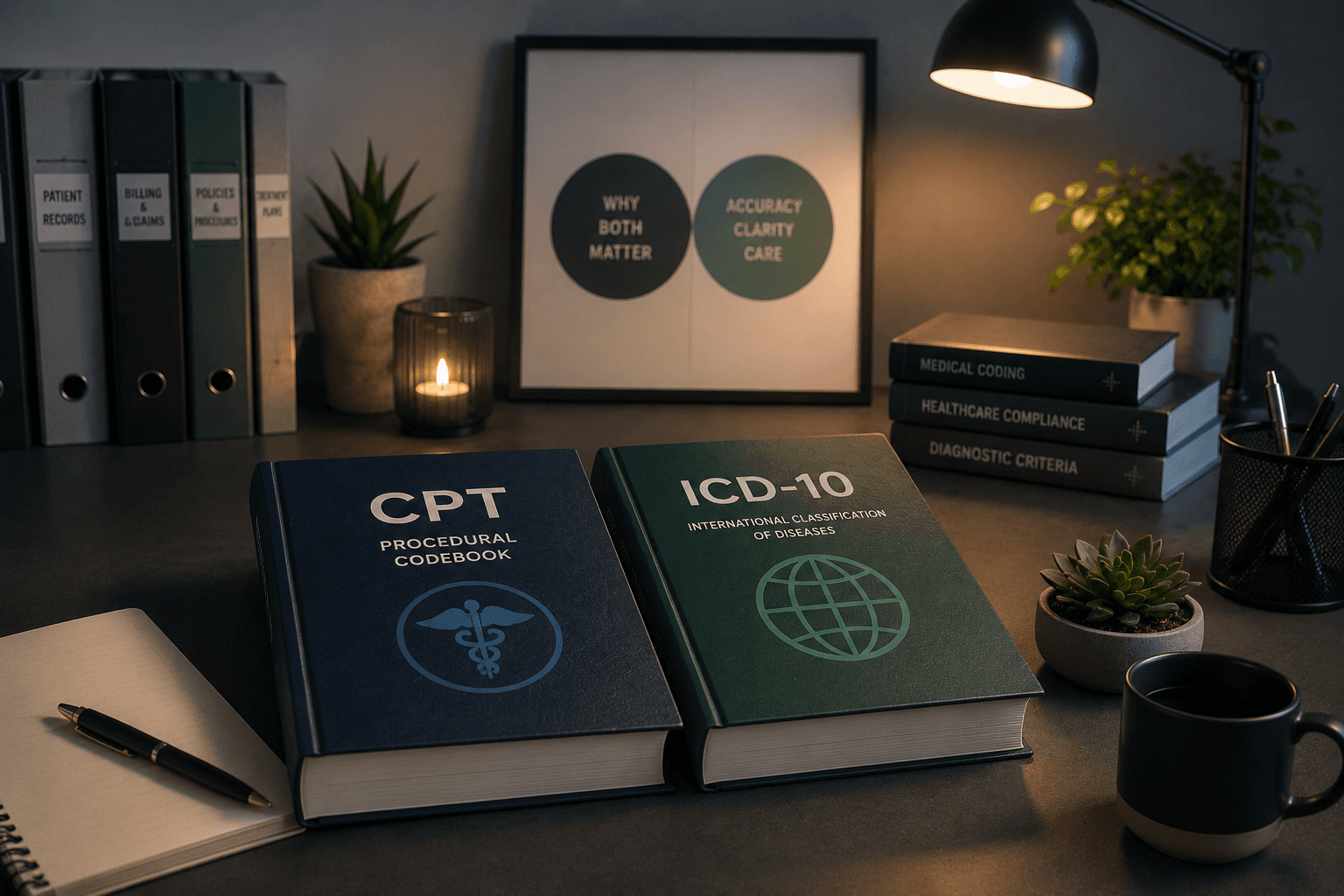
For a therapist in private practice, the distinction between a CPT code and an ICD-10 code is not merely administrative trivia. It is the difference between getting paid for your work and watching claims disappear into the void of payer processing systems. CPT and ICD-10 codes are the two essential languages of healthcare billing—one tells the payer what you did, the other tells them why you did it. Neither is sufficient alone; together, they establish the medical necessity that justifies reimbursement.
This article provides a comprehensive guide to understanding the relationship between CPT and ICD-10 codes, their distinct functions, and the practical implications of using them correctly in mental health practice.
The Fundamental Distinction: What vs. Why
The difference between CPT and ICD codes is elegantly simple, yet it is the source of endless confusion for clinicians new to billing.
CPT Codes: What Was Done
CPT (Current Procedural Terminology) codes are maintained by the American Medical Association (AMA) and describe the specific services and procedures provided to a patient. In mental health, CPT codes communicate the type of care given—individual therapy, family therapy, group therapy, or psychiatric evaluation.
90837: 60-minute individual therapy session
90834: 45-minute individual therapy session
90847: Family therapy with the patient present
90791: Psychiatric diagnostic evaluation without medical services
CPT codes are essential for determining reimbursement rates from insurance companies. They offer a standardized way to document and bill for the time and complexity of services provided.
ICD-10 Codes: Why It Was Done
ICD (International Classification of Diseases) codes, maintained by the World Health Organization (WHO), describe the diagnosis or reason for the care provided. In mental health, ICD-10 codes document the conditions you are treating.
F41.1: Generalized anxiety disorder
F33.2: Major depressive disorder, recurrent, severe
F43.10: Post-traumatic stress disorder, unspecified
F90.0: ADHD, predominantly inattentive type
F32.A: Major depressive disorder, single episode, mild with anxious distress
F43.8A: Prolonged grief disorder
ICD codes are also required for insurance claims, as they justify the medical necessity of the services billed using CPT codes.
The Relationship in One Sentence
A clean claim requires both codes: the CPT code tells the payer what service you provided, and the ICD-10 code tells them why that service was medically necessary. Together, they answer the two questions every payer asks: "What did you do?" and "Why did you do it?".
The Synergy: Why Both Codes Are Essential
CPT and ICD codes are not competing systems; they are complementary. They work in tandem to create a complete picture of the clinical encounter.
A Practical Example
Consider a client who presents for a 60-minute psychotherapy session for generalized anxiety disorder. The claim would include:
CPT 90837 (60-minute individual therapy)
ICD-10 F41.1 (Generalized anxiety disorder)
The CPT code tells the payer, "I spent 60 minutes providing individual psychotherapy." The ICD-10 code tells them, "I did this because the client has generalized anxiety disorder that requires treatment."
Without the CPT code, the payer would not know what service to reimburse. Without the ICD-10 code, they would not know why the service was medically necessary. With both codes, the claim establishes medical necessity and is eligible for reimbursement.
The Medical Necessity Link
For a claim to be reimbursed, the CPT code must be supported by a medically necessary ICD-10 diagnosis. If the diagnosis does not justify the level of service provided, the claim will be denied. For example, billing a 60-minute therapy session (90837) for a client with a Z-code (e.g., Z63.0 for relationship problems) without an underlying mental health diagnosis is unlikely to be reimbursed because relationship issues alone do not typically establish medical necessity for psychotherapy.
Coding in 2025–2026: What Has Changed
The coding landscape for mental health professionals continues to evolve. The 2025 updates brought notable changes impacting coding, documentation, and billing workflows.
ICD-10-CM Updates
The 2025 ICD-10-CM updates introduced new diagnosis codes:
F32.A: Major depressive disorder, single episode, mild with anxious distress
F43.8A: Prolonged grief disorder
These new codes provide greater specificity for conditions that were previously coded under broader categories. Clinicians should be aware of these updates to ensure their diagnoses reflect the most accurate and current coding options.
CPT Code Changes
Several CPT code changes also took effect in 2025:
90834 (45-minute psychotherapy): Definition expanded to accommodate sessions with additional therapeutic techniques
90837 (60-minute psychotherapy): Updated documentation requirements emphasize the specific therapeutic approach used
New codes were also introduced, including:
99417: For billing prolonged psychotherapy services extending significantly beyond the typical 60 minutes
96127: Brief emotional/behavioral assessment scoring (e.g., PHQ-9, GAD-7)
99494: Care management services for behavioral health conditions
Telehealth Coding
Telehealth billing guidelines for 2025 permanently authorized reimbursement for psychiatric diagnostic evaluations and 45-minute psychotherapy sessions delivered virtually. Modifier 95 continues to indicate telehealth services.
Common CPT Codes in Mental Health
The table below summarises the most commonly used CPT codes for mental health services, adapted from the AMA and current practice guides:
Category | Common CPT Codes | Description |
|---|---|---|
Psychiatric Diagnostic Evaluation | 90791, 90792 | Initial evaluation with or without medical services |
Individual Psychotherapy | 90832 (30 min), 90834 (45 min), 90837 (60 min) | Outpatient therapy sessions |
Family & Couples Therapy | 90846, 90847 | With or without patient present |
Group Therapy | 90853 | Non-family group sessions |
Crisis Psychotherapy | 90839, +90840 | Emergency stabilization |
Add-On Codes | +90785, +90833, +90836, +90838 | Additional services or complexity |
Behavioral Health Integration | 99484, 99492-99494 | Collaborative care management |
Testing & Assessment | 96130-96133 | Psychological testing and evaluation |
Session Time Requirements
Individual psychotherapy codes are time-based. The following time requirements apply:
Code | Session Time | Time Range |
|---|---|---|
90832 | 30 minutes | 16–37 minutes |
90834 | 45 minutes | 38–52 minutes |
90837 | 60 minutes | 53+ minutes |
Documentation of exact session times is essential to support these codes. A session that falls outside the designated time range should be billed with the appropriate code for the actual time spent.
The New Prolonged Services Code
For sessions extending significantly beyond 60 minutes, the new code 99417 allows mental health providers to bill for prolonged psychotherapy services. This code is particularly relevant for clinicians who regularly conduct extended sessions for trauma processing, intensive work, or complex presentations.
Add-On Codes: Capturing Complexity
Add-on codes represent time extensions or additional services beyond the base code. They are billed in addition to the primary CPT code.
Common add-on codes in mental health include:
+90785: Interactive complexity (e.g., interpreter use, child play therapy, difficult communication)
+90833: 30-minute psychotherapy add-on for medication management sessions
+90836: 45-minute psychotherapy add-on
Proper use of add-on codes increases reimbursement while maintaining compliance. However, they should only be used when the additional service is documented and justified.
ICD-10 Codes: Beyond the F-Codes
While F-codes (mental and behavioral disorders) are the primary focus for mental health clinicians, ICD-10 includes other relevant code categories:
Z-Codes: Factors Influencing Health Status
Z-codes describe circumstances that are not mental disorders but may affect a client's health or treatment. Common examples include:
Z63.0: Problems in relationship with spouse or partner
Z63.5: Disruption of family by separation and divorce
Z91.41: Personal history of adult abuse
Z59.6: Low income
Z55.9: Problems related to education and literacy
Z-codes can be used as secondary diagnoses to provide context for the primary mental health diagnosis. However, they are generally insufficient as the sole diagnosis to justify psychotherapy reimbursement.
New ICD-10 Codes for 2025-2026
The 2026 edition of ICD-10-CM became effective on October 1, 2025. Key updates include:
F32.A: Major depressive disorder, single episode, mild with anxious distress
F43.8A: Prolonged grief disorder
Updated definitions for F41.1 (GAD) with further subcategories for severity
Clearer distinctions for F43.1 (PTSD) between acute, chronic, and delayed onset
Common Coding Errors and How to Avoid Them
The most common billing failures are not clinical problems—they are documentation and coding mistakes. The table below outlines the key errors and their solutions:
Mistake | Impact | Solution |
|---|---|---|
Using incorrect session length | Underpayment or audit risk | Match documentation to time spent |
Missing add-on codes | Lost revenue | Always check session complexity |
Billing without diagnosis linkage | Claim denial | Verify CPT + ICD-10 pairing |
Using Z-codes as primary diagnosis | Claim denial | Use F-code as primary for therapy |
Confusing CPT and ICD codes | Claim errors | Remember: CPT = what, ICD = why |
Delayed claim submission | Missed timely filing deadlines | Submit claims promptly |
The Documentation- Coding Link
The most common source of coding errors is insufficient documentation. As the APTA notes, documentation should describe the patient's condition using terminology that includes specific diagnoses as well as symptoms, problems, or reasons for the encounter. Codes must be supported by the clinical record.
For mental health clinicians, this means:
Documenting session start and end times to support time-based CPT codes
Linking session content to the diagnosis to support ICD-10 codes
Documenting the specific therapeutic approach used
Including add-on code justification when applicable
Frequently Asked Questions (FAQ)
1. What is the difference between a CPT code and an ICD-10 code?
CPT codes describe the service provided ("what was done"), while ICD-10 codes describe the diagnosis or reason for the service ("why it was done"). Both are required for insurance claims.
2. Can I bill insurance with only a CPT code?
No. Insurance claims require both a CPT code (the service) and an ICD-10 code (the diagnosis). The ICD-10 code establishes medical necessity for the CPT code.
3. What CPT code should I use for a 60-minute therapy session?
For a 60-minute individual therapy session (53+ minutes), use CPT 90837. For a 45-minute session (38–52 minutes), use CPT 90834. For a 30-minute session (16–37 minutes), use CPT 90832.
4. Can I use a Z-code as the primary diagnosis for therapy?
Generally, no. Z-codes (e.g., Z63.0 for relationship problems) describe circumstances that are not mental disorders. Insurance typically requires a mental health diagnosis (F-code) as the primary diagnosis to establish medical necessity for psychotherapy. Z-codes may be used as secondary diagnoses.
5. What are add-on codes, and when should I use them?
Add-on codes represent additional services beyond the base code. Examples include +90785 (interactive complexity) and +90833 (30-minute psychotherapy add-on). They should only be used when the additional service is documented and justified.
6. How do I code telehealth sessions?
For telehealth sessions, append modifier 95 to the CPT code (e.g., 90837 with modifier 95). Telehealth billing guidelines for 2025 permanently authorize reimbursement for psychiatric diagnostic evaluations and 45-minute psychotherapy sessions delivered virtually.
7. What is the new prolonged services code for extended sessions?
99417 allows mental health providers to bill for psychotherapy sessions extending significantly beyond the typical 60 minutes. This is useful for clinicians who regularly conduct extended sessions.
8. What ICD-10 codes are new for 2025-2026?
New codes include F32.A (major depressive disorder, single episode, mild with anxious distress) and F43.8A (prolonged grief disorder). Updated definitions also apply to F41.1 (GAD) and F43.1 (PTSD).
References
Checkpoint EHR. (2025, February 6). The Difference Between CPT Codes and ICD Codes.
CBM Medical Management. (2025, December 16). Coding and Billing for Mental Health Services.
Ensora Health. (2024, December 13). 2025 updated CPT codes for mental health.
American Medical Association. (2025). CPT® Overview and Code Approval.
If you’re ready to spend less time on documentation and more on therapy, get started with a free trial today
Not medical advice. For informational use only.
Outline
More articles


