

Nov 25, 2025
ADHD makes traditional note-taking feel like an uphill battle. Your mind wanders during crucial meetings, important details vanish into thin air, and you later find yourself scrambling to remember where you stored that game-changing idea [7]. This ADHD Note-Taking Template was born from exactly that frustration.
Good notes serve as more than study aids for those of us with ADHD—they become essential tools for managing mental demands and strengthening memory retention [3]. The struggle isn't rooted in laziness or lack of intelligence. Rather, it stems from how ADHD brains handle and organize incoming information [3].
Working memory constraints make the simultaneous tasks of listening, processing, and writing exceptionally demanding [7]. Standard note-taking methods become exercises in futility rather than helpful documentation systems.
ADHD writers often develop complicated relationships with note-taking [7]. Progress starts with acknowledging that our brains don't always operate as reliable filing systems [7]—and that's completely normal. What works better is a flexible, searchable approach built for minds that think in webs rather than straight lines.
This article presents a tested ADHD note-taking template that works with your natural thinking patterns instead of fighting them. You'll discover a multi-section layout designed to bypass executive function hurdles while capturing information in ways that actually make sense for your unique mental processes.
Why Traditional Note-Taking Fails the ADHD Brain
Standard note-taking systems were built for neurotypical brains. What appears logical and organized to most people transforms into a confusing labyrinth for those with ADHD. Recognizing why conventional methods fall short provides the foundation for building something that actually works.
The executive function gap
ADHD directly impacts executive functions—the mental skills that help us plan, organize, and regulate daily tasks. These deficits create substantial obstacles when attempting effective note-taking.
Both students and adults with ADHD encounter significant hurdles with note-taking due to working memory issues, transcription difficulties, and listening comprehension challenges [1]. Working memory constraints make holding information while writing it down exceptionally difficult. Research demonstrates that individuals with ADHD show slower handwriting speeds compared to neurotypical individuals, directly affecting their ability to keep pace with lectures or conversations [1].
These challenges reach far beyond classroom settings. Approximately 40-60% of adults with ADHD face unemployment or underemployment, with adult ADHD linked to over 120 million lost workdays of productivity annually in the United States alone [2]. This productivity gap partially stems from struggles with information management and organization—areas where effective note-taking provides direct support.
Executive function difficulties appear as:
Uncertainty about which information deserves documentation
Struggles with starting the note-taking process
Inability to maintain focus long enough for complete capture
Challenges organizing notes for future retrieval
Why linear notes don't work for non-linear minds
ADHD brains process information through non-linear, associative patterns rather than the sequential flow that traditional note-taking assumes. As one expert explains, "The ADHD brain often processes information in parallel rather than sequentially, which can lead to brilliant insights but challenges when trying to communicate within traditional linear frameworks" [3].
Many individuals with ADHD "don't learn in a linear fashion. They tend to ping pong all over the place, bouncing from topic to topic based on what they're interested in" [4]. This creates a fundamental disconnect with conventional note-taking methods that expect information to flow in straight lines.
ADHD thinking patterns typically follow a "start in the middle and work outward" approach [5]. Hierarchical folder systems and linear notes become traps because they conflict with how ADHD brains naturally link concepts. "Out of sight, out of mind" becomes reality as crucial information disappears within nested hierarchies [2].
The science behind non-linear thinking includes lower dopamine and norepinephrine levels affecting reward pathways, prompting the brain to seek stimulation through varied thought patterns [5]. Atypical Default Mode Network activity creates persistent mental "chatter" that simultaneously pulls attention in multiple directions [5].
The emotional toll of messy notes
Disorganized notes create costs that extend beyond practical inconvenience. For someone with ADHD, cluttered information systems become constant visual reminders of perceived inadequacies and incomplete tasks [6].
These persistent reminders trigger cascading negative emotions:
Anxiety increases as disorganized information represents endless pending decisions [6]. The overwhelming nature of messy notes often leads to complete system avoidance, worsening the problem progressively [7]. Shame and embarrassment from disorganization damage self-esteem and confidence [7].
This emotional burden creates a destructive cycle. Messy notes generate anxiety, leading to avoidance, which creates more disorganization and deeper inadequacy feelings. Many with ADHD eventually abandon note-taking entirely, losing the substantial benefits this practice could provide.
Understanding these specific challenges reveals why traditional note-taking fails ADHD brains—and highlights the need for an entirely different approach that supports rather than fights neurodivergent thinking patterns.
The Core Template: A Layout That Matches How ADHD Brains Think
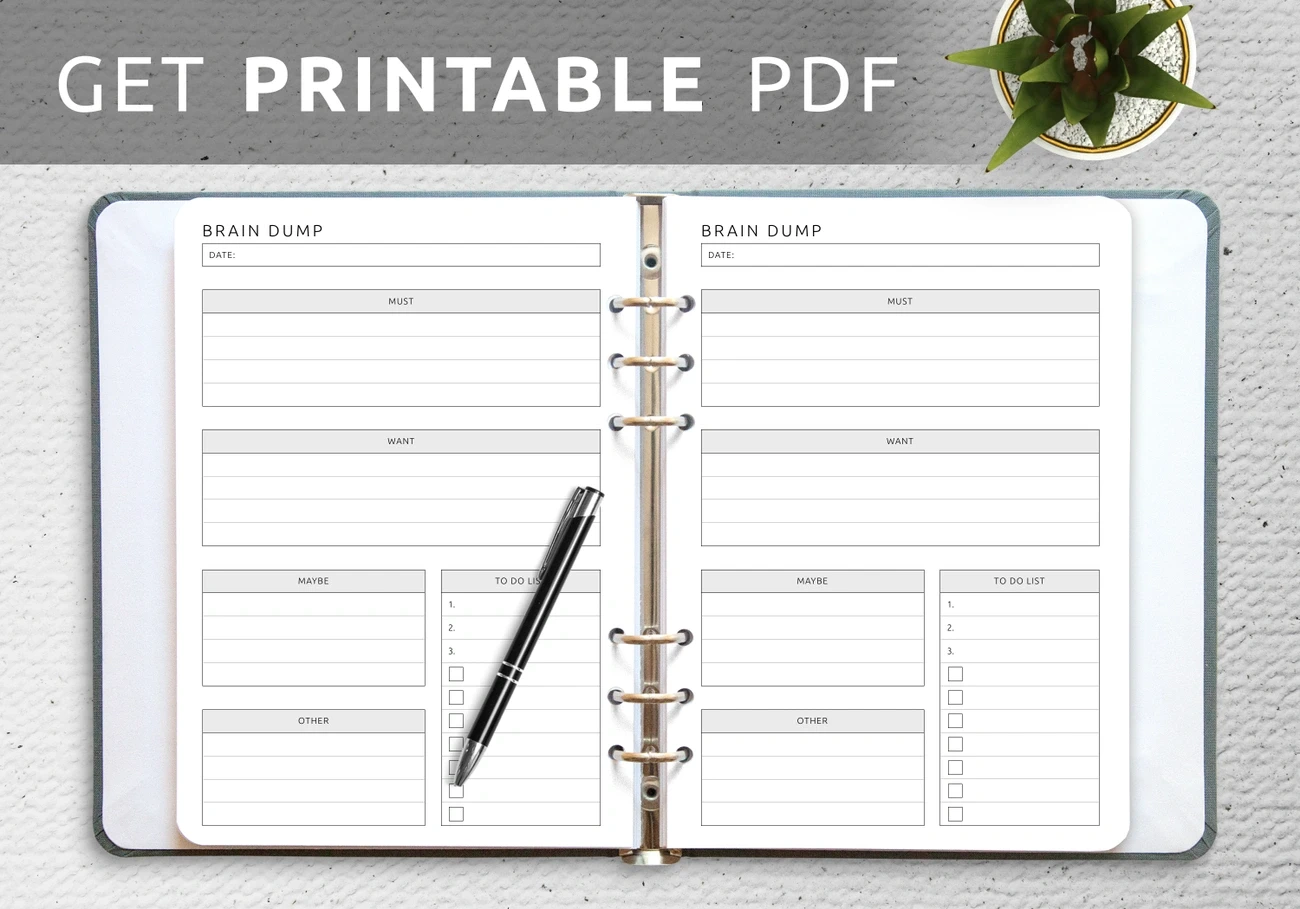
Image Source: OnPlanners.com
Understanding why traditional methods fail leads us to a better solution. This four-section template works with your natural thought patterns instead of fighting them. The layout addresses executive function challenges while providing structure that doesn't feel restrictive—exactly what ADHD minds need.
Section 1: The Capture Zone (Brain Dump)
Every effective ADHD note-taking system starts with a designated area for unfiltered thoughts—the "Capture Zone." This section serves as your brain dump: a space to quickly transfer all thoughts, ideas, and connections from your mind onto the page without judgment or immediate organization.
The research supports this approach. Brain dumping provides immediate stress relief and reduces anxiety by getting mental chaos out of your head [8]. This focused method clears mental clutter while restoring your sense of control over scattered thoughts.
The Capture Zone delivers specific benefits for ADHD minds:
Reduces mental load by freeing up working memory
Removes barriers that often prevent getting started
Respects your non-linear thinking patterns
Catches ideas before they disappear
Write freely in this section—start with whatever thought feels most urgent without worrying about perfect grammar or organization [8]. Your goal is capturing thoughts as they arrive, not creating polished content.
Section 2: The Main Thread (Key Concepts)
The Main Thread provides space to extract and highlight key concepts from your brain dump. Here you identify patterns, pull out important ideas, and create clearer structure from your initial thoughts.
This section tackles a common ADHD challenge: filtering important information from background noise. Many people with ADHD experience "difficulty filtering insignificant details" [9], making it hard to identify what matters most.
The Main Thread functions as your organizing space—using headings, bullet points, and indentation to create visual clarity [9]. This structured approach breaks down complex topics and prevents information overload by separating main concepts from supporting details.
Section 3: The Action & Query Box (What Now?)
The third component directly addresses task initiation difficulties—one of ADHD's most frustrating challenges. The Action & Query Box turns passive notes into concrete next steps.
Research shows that automatic task extraction significantly reduces manual effort and mental fatigue typical of traditional note-taking [2]. This section prevents notes from becoming another source of overwhelm by immediately connecting information to action.
Your Action Box should contain:
Clear, specific next steps
Questions requiring answers
Follow-up items with deadlines
People to contact
Studies confirm that ADHD minds benefit from having tasks automatically gathered from notes, creating a complete task system without manual list-building [10].
Section 4: The Emotional Margin (Feelings Filter)
The final component addresses something conventional note-taking systems ignore—the Emotional Margin. This space acknowledges that ADHD experiences involve both cognitive and emotional elements.
Emotional regulation challenges are central to ADHD, yet most note-taking methods overlook this entirely. The Emotional Margin provides space to track how you feel about information, identify resistance sources, and note when something triggers anxiety or excitement.
This section creates what researchers call a "brain break/doodle box" that supports longer focus periods and reduces overwhelm [11]. Tracking emotional responses helps identify patterns that might interfere with information processing and retention.
These four interconnected zones create a system that mirrors how the ADHD brain actually operates—capturing rapid thoughts, extracting meaningful patterns, connecting information to action, and acknowledging emotional responses. The template embraces and structures your natural cognitive style rather than forcing linear thinking.
Analog vs Digital: Choosing the Right Format for You
Choosing between analog and digital formats for your ADHD note-taking template comes down to matching tools with your specific challenges. No perfect solution exists—only what works best for your unique situation and preferences.
Using dot-grid journals for analog flexibility
Physical writing creates stronger connections to information for many ADHD individuals. Dot-grid journals strike an ideal balance between structure and freedom, offering subtle guidance without the rigid constraints that can feel overwhelming.
Putting pen to paper activates different neural pathways than typing, potentially strengthening memory and cognitive processing. One ADHD journaler captures this perfectly: "I love planners. I love organizers. I've always been drawn to anything that promises to Tame the Chaos, because there is a staggering amount of internal chaos that comes with having an ADHD brain."
Dot-grid journals offer distinct advantages:
Freeform drawing alongside text
Visual thinking support through diagrams and mind maps
Freedom from perfectly aligned writing pressure
Bullet journaling won't solve every organizational challenge, but it excels at reducing mental load. ADHD users frequently report "a huge difference on days when I offload to my bullet journal vs. days I try to keep everything in my head," experiencing less overwhelm and anxiety.
Digital tools that support ADHD workflows
Digital solutions provide powerful features designed for executive function challenges. Apps offer automated organization, reminders, and searchability that paper systems simply cannot match.
Google Keep stands out as particularly ADHD-friendly with its simple interface and robust search capabilities. One expert notes, "I don't waste time organizing—I just search for keywords or titles," which aligns perfectly with how ADHD brains prioritize speed over careful filing systems.
Voice assistants serve as external memory supports, enabling immediate capture of ideas, reminders, or tasks before they vanish from working memory. This "capture now, organize later" approach prevents the common ADHD experience of thought evaporation.
A hybrid approach often works best. One ADHD journal user acknowledges, "I still need a digital calendar I can share with my team... I still need a notepad on my phone to dump stuff when my bullet journal isn't by my side."
Voice-to-text and audio capture options
Speaking thoughts often feels faster and more natural than writing for many with ADHD. Voice-to-text technology has advanced significantly, offering excellent solutions for rapid idea capture without the executive function demands of typing or writing.
Apps like Audionotes specifically target ADHD users by transforming "fuzzy voice notes, text notes and images into structured text summaries." The app recognizes that unloading thoughts verbally often feels more accessible than writing, automatically organizing verbal content into actionable insights.
Voice recording benefits include:
Support for 80+ languages with auto-detection
Speaker recognition to distinguish between different people
Automated summaries highlighting key ideas and action points
Starting with whichever medium feels most frictionless makes sense. Trying several formats simultaneously might feel overwhelming. Consistency trumps perfection every time.
Making the Template a Habit, Not a Hassle
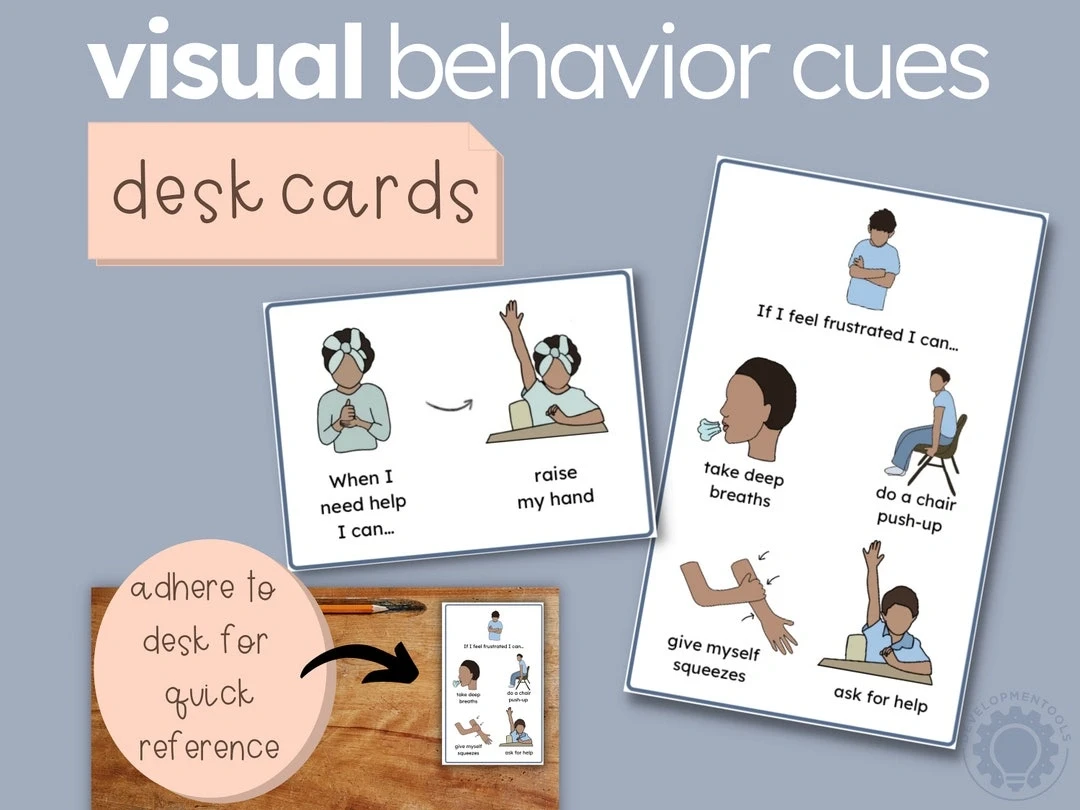
Image Source: Etsy
The best note-taking template becomes worthless without consistent use. A system alone won't solve your challenges—you need reliable habits that work even during difficult ADHD days. Here's how to shift this template from a good idea into automatic daily practice.
Start with one context (e.g., meetings or therapy)
System overwhelm destroys more ADHD organization attempts than any other factor. Rather than attempting to overhaul all your note-taking at once, select one specific situation where improved notes would create the most immediate impact:
Team meetings where action items regularly slip through the cracks
Therapy sessions where valuable insights disappear before your next appointment
Classes where essential concepts become a blur
Planning sessions where brilliant ideas never translate into action
Focus on mastering the template in that single context first. Gradual expansion works better once the process feels natural. This targeted approach sidesteps the perfectionism that frequently sabotages ADHD organization efforts.

Use visual cues and reminders
ADHD brains respond strongly to visual triggers that create nearly automatic habits. Effective visual cues need three key qualities: they must grab attention immediately, appear consistently in the same environment, and connect directly to clear actions without requiring complicated decisions.
Standard reminders often fail due to inattentional blindness—we stop seeing things that stay in our visual field too long. Combat this with strategic approaches:
Color coding creates visual consistency that helps your brain categorize activities quickly
Strategic positioning places your template or device directly next to items you always use in your chosen context
Movement-based triggers work with your natural patterns, like placing a visual reminder where you'll definitely see it
Digital templates benefit from distinctive notification sounds or a bright physical object placed near your workspace as a concrete reminder.
Build a 2-minute tidy-up ritual
Spend exactly 1-2 minutes organizing what you've captured immediately after using your template. This brief habit prevents information from becoming another source of clutter while respecting your limited executive function resources.
The 2-minute process includes four steps:
Clarify: Write a one-line summary at the top
Tag: Add 1-2 relevant categories
Extract: Identify at least one follow-up task
Schedule: Put that follow-up on your calendar immediately
This addresses the common ADHD complaint: "I take notes but never review them." Without explicit next steps, notes just create more overwhelm.
Add a weekly review ritual—10-15 minutes to consolidate scattered notes into projects or archive them. Keep this process visual and rewarding by pairing it with something you enjoy, like a favorite drink or background music.
Consistency matters more than complexity. A simple system you actually use beats an elaborate one that feels overwhelming every time.
Real-Life Use Cases: How This Template Works in Practice
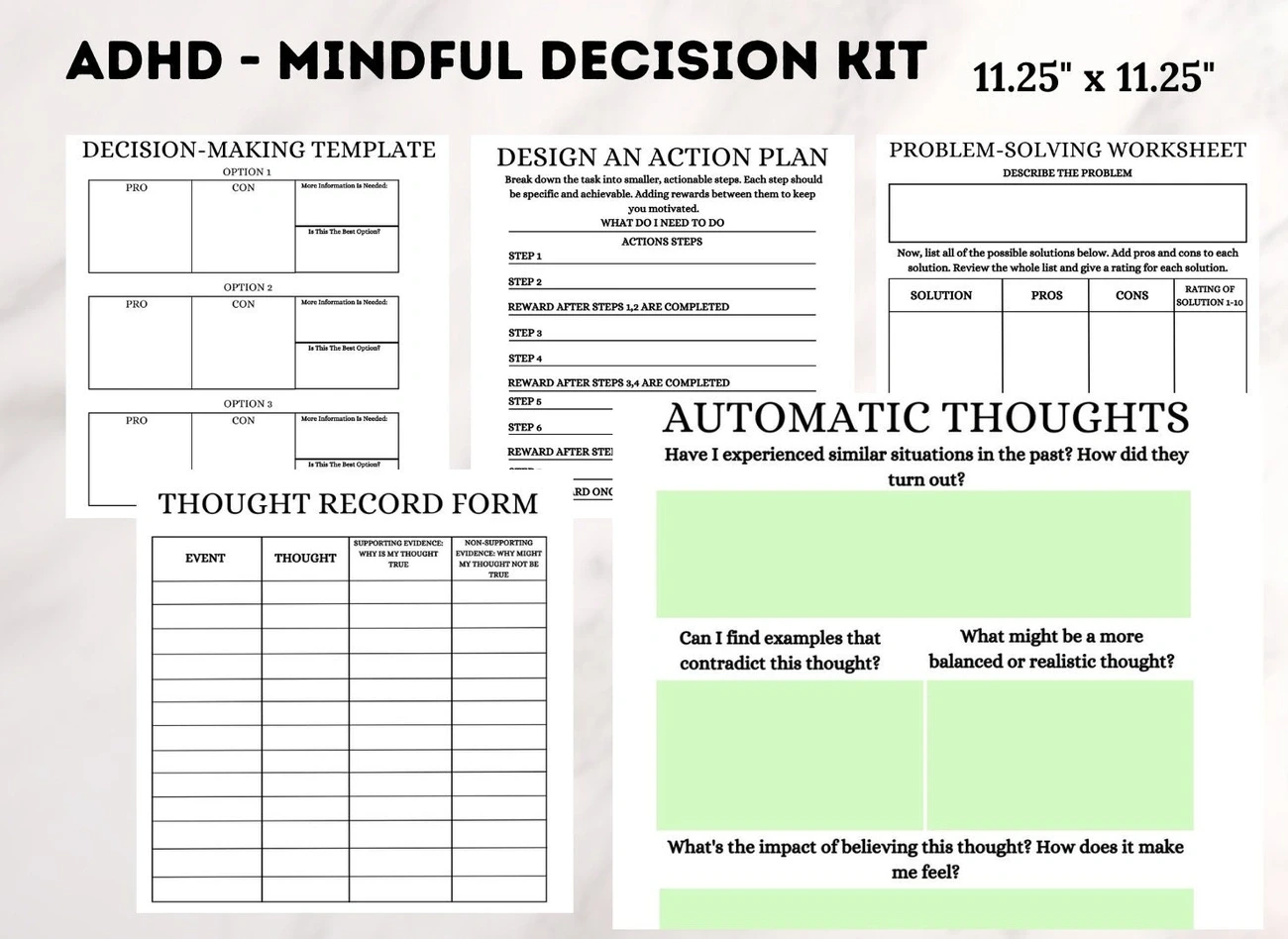
Image Source: Etsy
Practical examples reveal the template's true value. Here's how this four-section approach performs in real situations that challenge ADHD attention and organization.
In a fast-paced lecture
Professor Martinez delivers Psychology 101 at breakneck speed, covering classical conditioning concepts faster than most students can absorb. The template handles this perfectly. Keywords flow into the Brain Dump section while audio recording captures everything else. Timestamps mark critical moments: "00:12:30 — Exam focuses on real-world examples" and "00:25:45 — Follow-up assignment mentioned."
This prevents the familiar struggle of missing information while frantically writing. The Main Thread section organizes key concepts: unconditioned stimulus → unconditioned response, plus modern applications. Clear next steps appear in the Action Box: "Review recording sections 12:30-15:00 by Thursday" and "Find 3 classical conditioning examples for assignment."
During a therapy session
Therapy insights disappear faster than morning coffee steam. This template changed that pattern entirely. The Capture Zone receives thoughts as they surface—no organization required. After discussing a childhood breakthrough, the therapist's exact words go down in quotes.
The Emotional Margin earns its place here. Feelings get tracked throughout: "Anxious discussing work deadline → relieved after sharing → curious about childhood connection patterns." These emotional markers create visible progress over time, making therapy gains concrete rather than fleeting impressions.
At a team meeting
Sprint planning moves at digital speed with multiple voices adding complexity. The template's structure handles this chaos smoothly. Main notes occupy the right side while cues and keywords anchor the left. Under "login bug," the notation "Sarah, due Monday" creates instant visual reference.
The Action Box becomes essential for workplace survival, immediately capturing assignments: "Follow up with Sarah on database migration — by Wednesday — HIGH priority." This system eliminates missed deadlines and forgotten commitments from rapid-fire discussions.
For personal planning or journaling
Personal goals often create the biggest organizational challenges. Researching UX design bootcamps generated information overload until the template stepped in. The Brain Dump collected scattered details about programs, costs, and schedules without forcing immediate decisions.
The Main Thread section synthesized this chaos into coherent comparisons. The Action Box held manageable next steps: email the community college about evening programs, check employer tuition reimbursement, and connect with program graduates on LinkedIn. These small, specific actions prevented research paralysis while maintaining forward momentum.
Customizing the Template for Your Needs
This template's strength comes from its flexibility. Once you grasp the basic four-section structure, you can adapt it to practically any situation where your ADHD brain needs organizational support.
Adapting for students vs professionals
Students and professionals face different information challenges. Students deal with structured lectures that move at predetermined speeds, while professionals handle unpredictable meetings and shifting project demands.
Students benefit from expanding the Capture Zone to handle rapid-fire lecture content. Link your notes directly to textbook chapters or assignment requirements. Professionals often need a larger Action Box to track delegated responsibilities and shifting deadlines.
Mind mapping serves both groups effectively, organizing information visually in ways that feel more natural and memorable [12]. The visual connections help ADHD brains see relationships between concepts that linear notes might miss.
Adding ADHD coaching note-taking techniques
ADHD coaches frequently emphasize visual learning approaches since "ADHD brains often learn better with visuals" [13]. Color-coding different types of information creates instant visual categories. Simple diagrams and symbols can replace lengthy text descriptions.
The Cornell Method provides structured flexibility that supports executive function challenges [14]. Its cue column, main notes section, and summary area mirror the organization your ADHD brain craves without feeling restrictive.
Reading notes aloud within 24 hours strengthens retention by engaging multiple processing channels simultaneously: visual, auditory, and motor [15]. This multi-sensory approach works particularly well for ADHD learners who benefit from varied input methods.
Using it with ADHD worksheets or session materials
Integrate existing therapeutic materials by adapting them to your template zones rather than starting from scratch. Therapy notes work well when you designate specific space for insights alongside homework assignments.
Keep everything in one central location [16]. This approach reduces the mental energy spent hunting for information across multiple notebooks, apps, or folders. Your ADHD brain will thank you for eliminating that constant search-and-rescue mission.
Conclusion
Finding systems that support your ADHD brain rather than fight against it changes everything. This four-section template provides a practical method for capturing information that respects your non-linear thinking, working memory limitations, and emotional responses.
This template serves as your foundation, not a rigid rulebook. Real effectiveness comes from adaptation—adjusting section sizes, formats, or functions to match your specific requirements. Your ADHD brain deserves tools designed for your actual thinking patterns, not idealized versions of how you "should" think.
Begin with one specific context where improved notes would immediately reduce your daily stress. Expand gradually as the system becomes second nature. Perfect notes aren't the goal—accessible information that returns when you need it matters most.
Practice patience with yourself throughout this process. Many of us carry internalized shame about disorganization, mistaking neurological differences for personal failings. Consistent use of this template can reshape your entire relationship with information management.
Effective note-taking isn't about becoming someone different. It's about honoring your brain's unique strengths while providing support for its challenges. This template delivers that balance: structure without rigidity, organization without constraint, and reliability even during your most difficult ADHD days.
This template offers practical support for executive function challenges while complementing professional guidance. These strategies work best alongside other ADHD management approaches tailored to your specific circumstances.
Your ideas, insights, and important details deserve to be captured and accessible—not lost in mental chaos. Previous note-taking failures reflect system mismatches, not your capabilities. With this template supporting you, those valuable thoughts will finally stay where you can find them.
Link to ADHD professionals and therapy support can provide additional guidance for managing ADHD symptoms beyond note-taking strategies. The National Institute of Mental Health offers evidence-based information about ADHD management approaches. For comprehensive support, CHADD (Children and Adults with ADHD) provides resources and community connections for individuals and families affected by ADHD.
Ready to improve your ADHD note-taking system?
Managing ADHD symptoms requires comprehensive support that extends beyond note-taking templates. Mental health professionals can provide personalized strategies for executive function challenges, working memory issues, and emotional regulation difficulties common in ADHD.
Yung Sidekick offers specialized support for therapy sessions through automated session recording and intelligent note generation. Our AI-powered system captures session insights while you focus entirely on your therapeutic work, creating detailed progress notes and client reports without additional administrative burden.
Start using Yung Sidekick to enhance your ADHD management sessions
Key Takeaways
Here are the essential insights for creating an ADHD note-taking system that actually works with your brain:
• Use a four-section template: Capture Zone for brain dumps, Main Thread for key concepts, Action Box for next steps, and Emotional Margin for feelings—this matches non-linear ADHD thinking patterns.
• Start with one specific context like meetings or therapy sessions before expanding—system overwhelm is the biggest threat to ADHD organization methods.
• Choose analog or digital based on your preferences: Dot-grid journals offer flexibility while digital tools provide searchability and voice-to-text capabilities for rapid capture.
• Build a 2-minute tidy-up ritual immediately after note-taking to clarify, tag, extract actions, and schedule follow-ups—preventing notes from becoming forgotten clutter.
• Embrace your non-linear thinking style rather than forcing traditional hierarchical systems that don't match how ADHD brains naturally process and connect information.
The key is consistency over perfection. A simple system you actually use will always outperform an elaborate one that feels overwhelming. This template provides structure without constraint, honoring your brain's unique strengths while supporting its challenges.
FAQs
How does the ADHD note-taking template differ from traditional methods?
The ADHD note-taking template is designed with a four-section layout that matches non-linear thinking patterns. It includes a Capture Zone for brain dumps, a Main Thread for key concepts, an Action Box for next steps, and an Emotional Margin for feelings, addressing specific executive function challenges faced by individuals with ADHD.
Can this template be used in both digital and analog formats?
Yes, the template can be adapted for both digital and analog use. Dot-grid journals work well for analog flexibility, while digital tools offer features like searchability and voice-to-text capabilities. The choice between analog and digital depends on personal preferences and specific needs.
How can I make this note-taking system a consistent habit?
Start by implementing the template in one specific context, such as meetings or lectures. Use visual cues and reminders to prompt note-taking, and develop a quick 2-minute tidy-up ritual immediately after taking notes to organize and extract key information.
Is this template suitable for both students and professionals?
Absolutely. The template can be customized for various needs. Students might expand the Capture Zone for detailed lecture notes, while professionals could enlarge the Action Box for tracking tasks and deadlines. The core structure remains adaptable to different scenarios.
How does this template address emotional aspects of ADHD?
The template includes an Emotional Margin section, acknowledging that ADHD experiences are not purely cognitive. This space allows users to track emotional responses to information, identify sources of resistance, and note when something triggers anxiety or excitement, helping to manage the emotional aspects of ADHD.
References
[1] - https://reconfigured.io/blog/adhd-notes-that-work
[2] - https://www.audhdpsychiatry.co.uk/how-to-take-notes-with-adhd/
[3] - https://passionatewritercoaching.com/best-free-note-taking-apps/
[4] - https://www.additudemag.com/how-to-take-notes-adhd-handwritten-digital/?srsltid=AfmBOoouqvxzmD5LFZid-OkHE3A9ZEYHEOjdiRJyykZBBygXGXKvlgLL
[5] - https://yaranga.net/articles/2025-31-07-note-taking-for-adhd-a-system-to-end-overwhelm-and-organize-chaos
[6] - https://www.helloklarity.com/post/translating-non-linear-thinking-adhd-communication-strategies-for-the-workplace/
[7] - https://digcoaching.com/adhd-nonlinear-learning/
[8] - https://www.linkedin.com/pulse/reasoning-behind-non-linear-thinking-styles-adhd-brain-wingerter-wkvhc
[9] - https://advancedpsychiatryassociates.com/resources/blog/adhd-clutter-management-guide
[10] - https://www.grouporttherapy.com/blog/adhd-clutter-anxiety
[11] - https://janesagenda.com/blogs/planning-201/brain-dump?srsltid=AfmBOopXJc85MaSXrW3NTtibmjpV_bPzVakceZ_CFBpr3Fwvsd57Inmz
[12] - https://yaranga.net/articles/2025-18-08-brain-dump-bliss-how-yaranga-helps-adhd-minds-organize-overwhelming-thoughts
[13] - https://www.etsy.com/listing/4353455007/adhd-note-taking-templates-focus
[14] - https://adayinourshoes.com/note-taking-strategies/
[15] - https://www.saner.ai/blogs/note-taking-strategies-for-individuals-with-adhd
[16] - https://medium.com/@theo-james/note-taking-for-adhd-how-to-stay-organized-without-overwhelm-83ef42a73dee
[17] - https://www.additudemag.com/notes-on-taking-notes/?srsltid=AfmBOootKsCweNp1B9pfaIc_HlgmKY7BwwgEZ09kyiyiy6vfmZLf7aiL
[18] - https://ucalgary.ca/news/note-taking-adhd
If you’re ready to spend less time on documentation and more on therapy, get started with a free trial today
Not medical advice. For informational use only.
Outline