
Jul 13, 2026
Prolonged Exposure (PE) therapy stands as one of the most rigorously researched and consistently recommended treatments for posttraumatic stress disorder (PTSD). Developed by Edna Foa, Elizabeth Hembree, and Barbara Olasov Rothbaum, PE is a manualized, time-limited cognitive behavioral therapy that helps trauma survivors confront the memories, feelings, and situations they have avoided since their traumatic experience.
Clinical practice guidelines (CPG) consistently support PE as a first-line treatment, including the 2023 CPG produced by the Department of Veterans Affairs and the Department of Defense. The American Psychological Association's 2025 updated Clinical Practice Guideline for the Treatment of PTSD in Adults strongly recommends PE alongside Cognitive Processing Therapy (CPT) and trauma-focused CBT.
Yet despite its strong evidence base, PE remains underutilized in routine clinical practice. Therapists often cite concerns about dropout rates, patient distress during exposure, and the logistical challenge of 90-minute sessions. This article provides a comprehensive overview of PE therapy—its clinical components, evidence base, training pathways, documentation requirements, and practical strategies for implementation.
The Clinical Components of Prolonged Exposure
PE is built on the foundational premise that PTSD symptoms are maintained by avoidance—of trauma-related memories, cues, and emotions. By helping patients systematically approach what they have been avoiding, PE facilitates emotional processing and reduces pathological fear.
Core Treatment Components
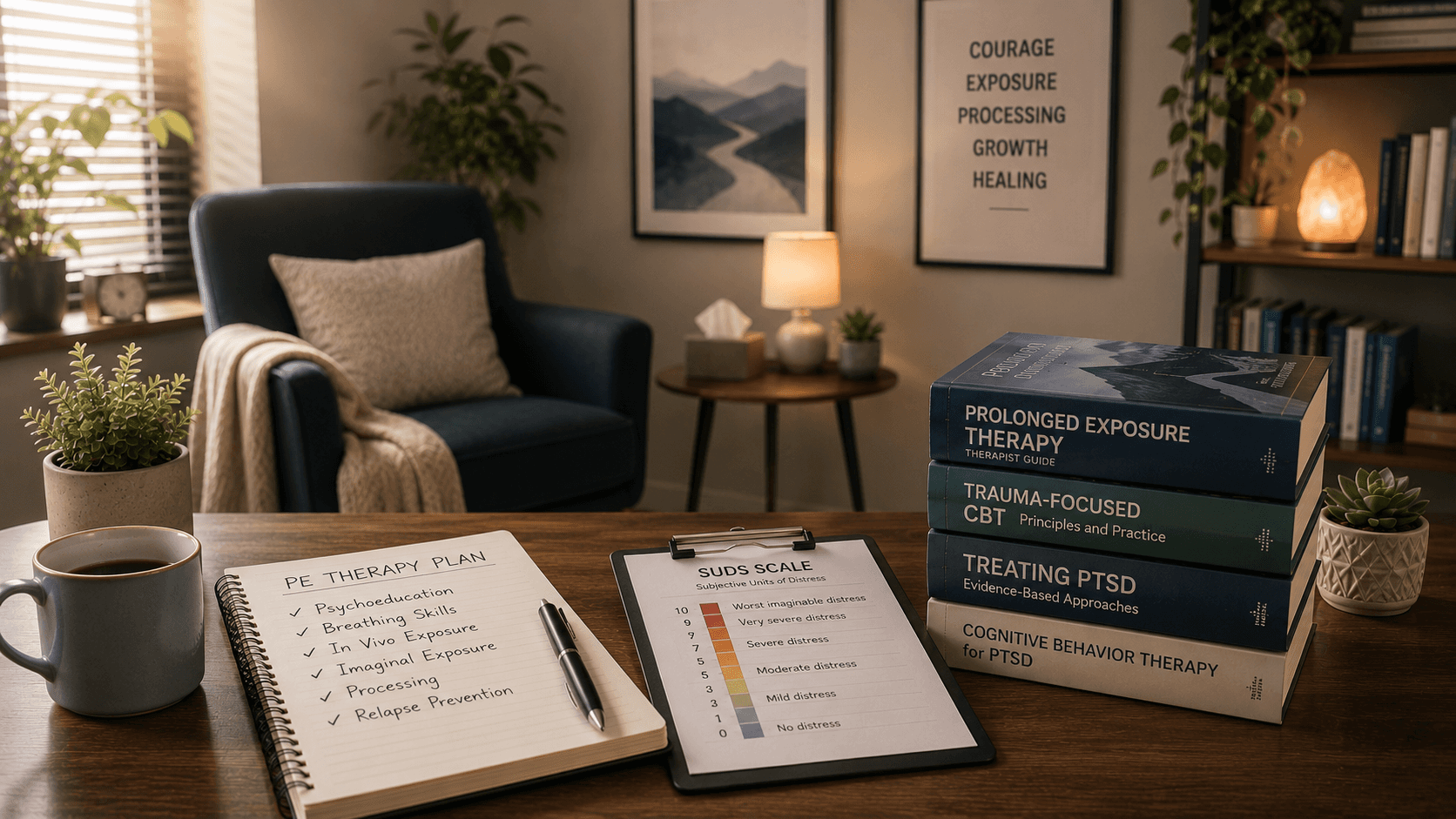
PE typically consists of 8 to 15 weekly sessions, each 90 minutes in length, though research supports effective delivery in 60-minute sessions. The treatment includes several key components:
1. Psychoeducation
The therapist provides a clear rationale for why exposure works, explaining the cycle of avoidance and how confronting trauma reminders can reduce fear. This foundation is essential for building rapport and treatment adherence.
2. Breathing Retraining
A brief breathing technique is taught to help patients manage anxiety during exposure exercises. While not the primary mechanism of change, it provides patients with a sense of control over their physiological arousal.
3. In Vivo Exposure
Patients gradually approach safe but avoided trauma-related situations, people, and places outside of therapy sessions. The therapist and patient collaboratively identify a hierarchy of feared stimuli and agree on a graduated plan for confrontation between sessions.
4. Imaginal Exposure
In session, the patient describes the traumatic event in detail in the present tense, with guidance from the therapist. The session is recorded so the patient can listen to it between sessions, further processing the emotions and practicing the breathing techniques. This repeated revisiting of the trauma memory helps reduce the intensity and frequency of intrusive symptoms.
5. Emotional Processing
Following imaginal exposure, the therapist and patient discuss and process the emotions raised by the exposure, exploring the meaning of the memory for the client at the time of the trauma and now.
The 60-Minute Adaptation
The original PE protocol was developed as 90-minute sessions, which can create a barrier in clinical settings where 60 minutes is standard. Research supports delivering PE effectively in 60-minute sessions without reducing impact on PTSD and depression symptoms. Therapists can adapt session structure by condensing psychoeducation, streamlining exposure, and ensuring homework assignments are clear and manageable.
The Evidence Base: Why PE Is a First-Line Treatment
Efficacy and Effectiveness
PE is strongly recommended by every major U.S. and international clinical practice guideline for the treatment of PTSD. A network meta-analysis found that CPT, EMDR, cognitive therapy, narrative exposure therapy, PE, CBT, and PCT were the most effective therapies for reducing PTSD symptoms, with large to moderate effects at post-treatment.
A recent 17-site VA national prospective study found that CPT and PE have similar results in improving PTSD symptoms. However, PE demonstrated an advantage over CPT in achieving symptomatic remission (20.4% vs. 12.6%, OR=1.6, 95% CI=1.2–2.0).
Comparative Effectiveness
Relative to CPT, PE is associated with greater reduction in 10 PTSD symptoms from first to final session of therapy. Treatment-specific effects emerged for symptoms relatively specific to the diagnosis of PTSD, such as avoidance and hypervigilance.
PE is recommended for patients who exhibit strong avoidance of trauma-related memories and stimuli and require exposure to reduce emotional reactivity. Both CPT and PE are effective, but the choice between them should be guided by patient preference and clinical presentation.
Suicide Risk Outcomes
A 2025 study comparing suicide mortality rates among 62,686 VA patients receiving CPT or PE found no statistically significant difference between the two treatments in the outcome of death by suicide. The hazard ratio for CPT versus PE was 1.25 in standard adjustment models and 1.22 in instrumental variable analyses, with neither reaching statistical significance.

Training and Certification Pathways
Foundational Training
PE training typically begins with intensive workshops ranging from 2 to 4 days. The University of Pennsylvania offers an Intensive Workshop in Prolonged Exposure Therapy for PTSD, which serves as the foundation for certification.
The 4-Day Intensive Online Training Workshop offered through the Psychologists' Association of Alberta covers the theoretical support for PE, main clinical techniques, step-by-step instructions for conducting PE sessions, and videotaped examples of PE cases. Participants practice PE techniques in role-plays during the workshop.
Certification
Certification as a PE Therapist typically requires completion of an intensive workshop followed by consultation leading to certification. The CE21 training is recognized by the CTSA and qualifies toward CTSA certification as a PE Therapist for participants who complete the required additional case consultation.
Training programs often recommend that participants be familiar with the evidence base supporting PE prior to attending and strongly encourage purchasing the Prolonged Exposure Therapy for PTSD Therapist Guide and Workbook (Second Edition).
Continuing Education
Numerous CE opportunities are available for therapists seeking to maintain or deepen their PE skills. The VA's National Center for PTSD offers a free online course, "Delivering Prolonged Exposure for PTSD in 60-Minute Sessions," which provides 1 hour of CE credit through multiple accrediting bodies including ACCME, ANCC, APA, ASWB, and NBCC.
Advanced training programs are also available, such as the "Advanced Implementation and Adaptation of Prolonged Exposure Therapy for PTSD" offering 13 AMA PRA Category 1 credits. DBT PE Intensive Training offers 26 hours of optional CE credits.
CPT Codes and Documentation
Standard Psychotherapy Codes
PE therapy is typically billed using standard individual psychotherapy CPT codes:
CPT Code | Description | Session Length | Typical Use in PE |
|---|---|---|---|
90837 | Individual psychotherapy, 53+ minutes | 60 minutes | Standard PE session |
90834 | Individual psychotherapy, 38-52 minutes | 45 minutes | Adapted or shorter PE sessions |
90832 | Individual psychotherapy, 16-37 minutes | 30 minutes | Brief check-ins or limited sessions |
90837 is the most commonly used code for PE, reimbursing approximately $140 per session under Medicare nationally as of March 2026. The code covers individual psychotherapy sessions of 53 minutes or more, appropriate when clinical complexity demands extended time—as in trauma-focused therapy.
For PE sessions that extend significantly beyond 60 minutes, prolonged services add-on codes (99354-99355) may be used with 90837.
Documentation Requirements
Effective PE documentation should include:
Session focus: Specify imaginal exposure, in vivo exposure, or emotional processing
Exposure details: Describe the content of imaginal exposure or the specific in vivo exercise
Patient response: Document SUDS ratings and emotional processing
Homework assignments: Specify what the patient will practice between sessions
Progress toward goals: Track reduction in avoidance and symptom improvement
Sample note for an imaginal exposure session:
"Patient engaged in imaginal exposure to the trauma memory for 35 minutes. She described the event in the present tense with therapist guidance. SUDS peaked at 85 and decreased to 60 by the end of the exposure. Emotional processing focused on the meaning of the memory—specifically, beliefs about personal responsibility. Recording provided for between-session listening. Homework: Listen to recording daily; complete in vivo exposure to [specific avoided situation]. Plan: Continue imaginal exposure next session."
Dropout Rates and Common Challenges
The Dropout Reality
While PE is highly effective, dropout remains a significant clinical challenge. A meta-analysis of 181 studies found that weekly trauma-focused approaches such as CPT and PE had the highest dropout rates: 40.1% and 34.7%, respectively. Virtual reality exposure therapy also showed high dropout at 37.2%. The weighted dropout rate for all PTSD interventions was 25.6%.
Predictors of Dropout
Research investigating predictors of treatment outcome and dropout found that benzodiazepine use was related to both treatment outcome and dropout, and alcohol use to dropout. Demographic variables, depression, general anxiety, personality, trauma characteristics, and feelings of anger, guilt, and shame were not related to either treatment outcome or dropout—disconfirming generally held beliefs about these factors as contraindications for exposure therapy.
Strategies for Engagement
Clear rationale: Ensure patients understand why exposure works
Collaborative pacing: Allow patients to guide the pace of exposure
Addressing fears: Explicitly discuss fears about the treatment itself
Peer support: Research suggests peer support during in vivo exposure homework may increase likelihood of PE completion
Alternative formats: Massed formats (multiple sessions per week) have demonstrated promise for increasing treatment retention
Contraindications and Precautions
Contrary to common belief, depression, general anxiety, personality factors, and trauma characteristics have not been found to predict poorer outcomes or higher dropout. However, clinicians should be mindful of:
Active substance use: Alcohol use was related to dropout
Benzodiazepine use: Related to both treatment outcome and dropout
Suicidality: Standard risk assessment and safety planning should be in place
Comparison with Other PTSD Treatments
PE vs. CPT
Both PE and CPT are strongly recommended by APA guidelines. Key differences include:
Aspect | PE | CPT |
|---|---|---|
Primary mechanism | Exposure to trauma memories and cues | Cognitive restructuring of trauma-related beliefs |
Key activities | Imaginal and in vivo exposure | Written trauma accounts and Socratic dialogue |
Patient engagement | Actively confronting avoided stimuli | Examining and challenging beliefs |
Remission rates | 20.4% in recent study | 12.6% in recent study |
PE vs. EMDR
PE stands as the most extensively researched treatment for PTSD, with the strongest recommendation as a treatment for PTSD in every clinical practice guideline. EMDR, while showing efficacy, received only a moderate rating from the APA guideline, indicating less comprehensive evidence compared to PE.
PE vs. Written Exposure Therapy (WET)
WET is a brief, 5-session exposure-based treatment that has gained traction in VA settings. While less time-intensive than PE, it is considered a gold-standard treatment alongside CPT, PE, and EMDR.
Practical Implementation
Session Structure
A typical PE session sequence includes:
Check-in (5-10 min): Review homework, assess symptoms
In vivo exposure review (10-15 min): Discuss homework experiences
Imaginal exposure (30-40 min): Revisit trauma memory
Emotional processing (10-15 min): Process the experience
Homework assignment (5 min): Set next week's goals
Adapting for Complex Presentations
For patients with complex trauma histories, therapists may need to:
Spend additional sessions on stabilization and grounding
Allow more time for emotional processing
Address multiple traumatic events systematically
Consider integrating PE with DBT for emotion dysregulation
The Role of the Therapist
The therapist's stance in PE is active and directive but collaborative. Key therapist competencies include:
Clear communication: Providing a compelling rationale for exposure
Empathic presence: Creating a safe therapeutic relationship
Flexible pacing: Adjusting to patient readiness
Skilled coaching: Guiding imaginal exposure and processing
Homework follow-through: Ensuring patients complete between-session assignments
FAQ
How long does PE therapy typically take?
PE typically consists of 8 to 15 weekly sessions, with 60- or 90-minute sessions. The original protocol was 9 to 12 sessions of 90 minutes each, but 60-minute adaptations have been shown to be effective.
Is PE safe for patients with complex trauma?
Yes, but therapists may need to modify the approach. PE has been shown effective for patients with complex trauma presentations, and standard contraindications like depression or personality factors do not predict poorer outcomes. However, additional stabilization work may be needed for patients with severe dissociation or active crisis.
What is the dropout rate for PE?
Meta-analyses show PE dropout rates around 34.7%, with weekly trauma-focused approaches generally having higher dropout rates than other formats. Massed formats (multiple sessions per week) have shown promise for increasing treatment retention.
What CPT code should I use for PE sessions?
Use 90837 for 60-minute PE sessions (53+ minutes). This is the standard code for trauma-focused therapy requiring extended session time. For sessions that extend beyond 60 minutes, prolonged services add-on codes may be used.
How does PE compare to CPT?
Both are strongly recommended by APA guidelines. PE focuses on exposure to trauma memories and cues, while CPT focuses on cognitive restructuring of trauma-related beliefs. Both are effective, but PE may have an advantage in achieving symptomatic remission (20.4% vs. 12.6%).
What training is required to deliver PE?
Training typically begins with an intensive 2- to 4-day workshop, followed by consultation leading to certification. The VA offers free online CE courses, and numerous training organizations provide live and online training opportunities.
Can PE be delivered via telehealth?
Yes. PE can be effectively delivered via telehealth, with CPT code 90837 appended with modifier 95 for telehealth services. Many training programs now offer online training and supervision in telehealth delivery.
What is the role of breathing retraining in PE?
Breathing retraining is taught early in treatment to help patients manage anxiety during exposure exercises. While it is not the primary mechanism of change, it provides patients with a sense of control over their physiological arousal.
References
APA. (2025). Prolonged Exposure (PE). APA Clinical Practice Guideline for the Treatment of PTSD.
APA. (2025). Treatments for PTSD. APA Clinical Practice Guideline.
Behave Health. (2026). CPT Code 90837: Psychotherapy, 60 Minutes.
Deployment Psych. (2026). Prolonged Exposure Therapy for PTSD (22-23 Jun, 2026).
If you’re ready to spend less time on documentation and more on therapy, get started with a free trial today
Not medical advice. For informational use only.
Outline
More articles