
May 7, 2026
Schizophrenia is diagnosed when a patient’s psychotic episode has lasted six months and includes at least two hallmark symptoms. delusional disorder, by contrast, requires only one month of delusions with no other psychotic features. Meanwhile, brief psychotic disorder captures someone who has a sudden, florid break with reality lasting less than one month, with full return to premorbid function. But here is where it gets tricky—the presentation of first-episode psychosis in an older patient might look identical to dementia with Lewy bodies or Alzheimer's, yet the ICD‑10 pathway diverges dramatically. This is not just an academic distinction. The F20-F29 category is the most clinically charged and administratively scrutinized range in all of mental health coding.
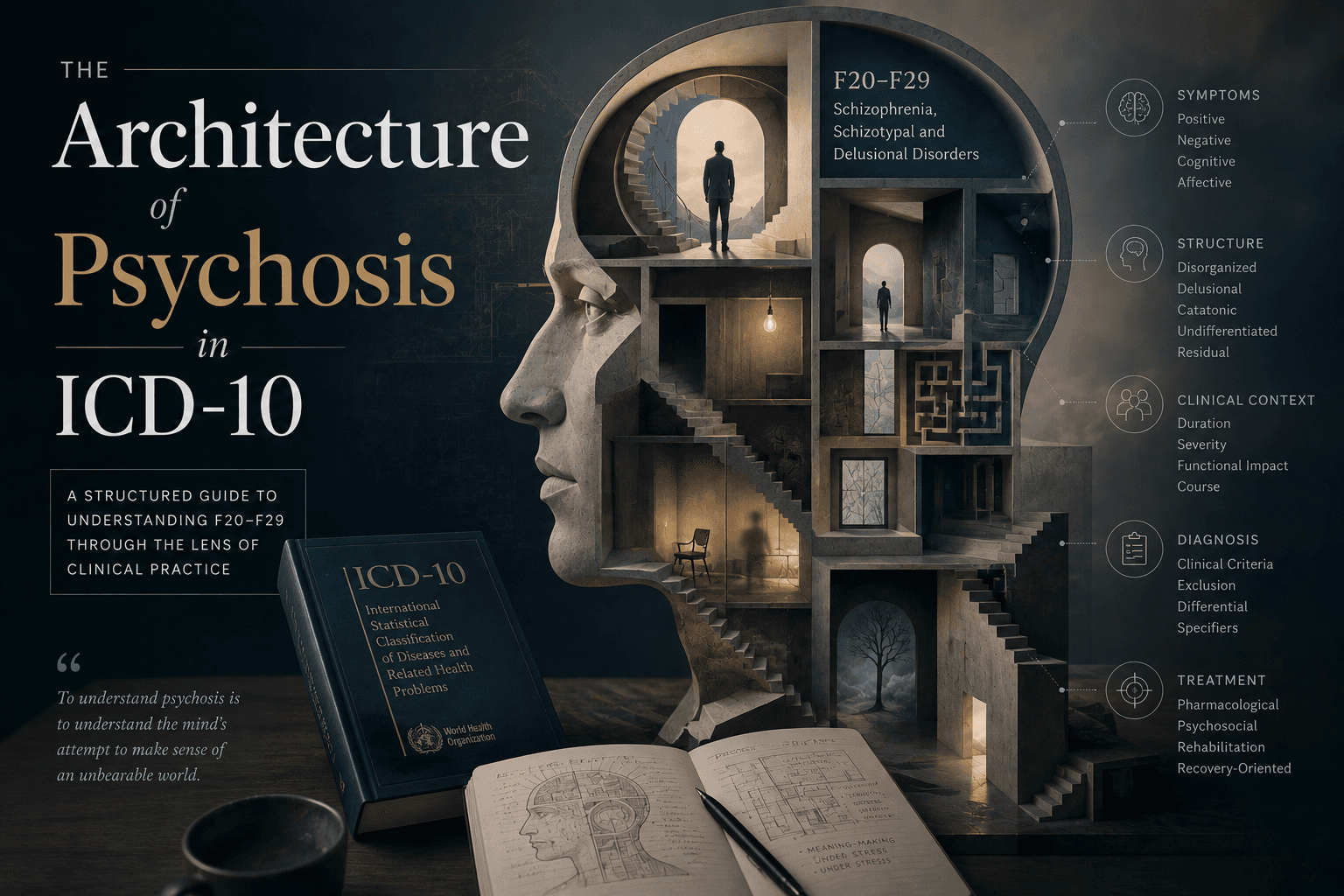
This article examines the diagnostic architecture, differential mapping, and evolving frontiers of the ICD‑10 psychosis codes—not as a catechism of criteria, but as a practical framework for clinical reasoning, risk stratification, and defensible documentation.
The Diagnostic Architecture of the F20-F29 Family
The ICD‑10 range F20‑F29 (Schizophrenia, schizotypal, delusional, and other non‑mood psychotic disorders) contains 11 billable codes covering the full spectrum of primary psychotic illness. The hierarchy is logical: F20 (Schizophrenia) is subdivided by classical subtypes, with F20.9 (Unspecified schizophrenia) the default code now that DSM‑5 has eliminated the subtypes entirely. F21 (Schizotypal disorder) occupies an ill‑defined borderland, while F22 (Delusional disorders) captures monodelusional presentations without functional deterioration.
F23 (Brief psychotic disorder) is reserved for acute, time‑limited episodes lasting less than one month, often stress‑precipitated. F24 (Shared psychotic disorder) codes the rare and vanishing condition of induced delusions. F25 (Schizoaffective disorders) is the only code in this range that explicitly requires both psychotic and mood symptoms and is now subdivided into bipolar type (F25.0), depressive type (F25.1), and other or unspecified. F28 is a narrow residual category for "other" non‑organic psychosis, and F29 is the catch‑all for unspecified psychosis.
Unspecified psychosis (F29) is properly used when psychotic symptoms are present, but the clinician cannot yet determine the specific disorder and has ruled out substance‑induced or medical causes. It is not a "wastebasket" for inadequate work‑ups. Overuse of F29 without ruling out specific organic or substance‑induced etiologies triggers audits and undermines clinical credibility.
The Differential Mapping: Late‑Onset Psychosis and Neurodegenerative Disease
The diagnostic challenge of distinguishing very late‑onset schizophrenia (VLOS) from neurodegeneration is one of the most treacherous areas in geriatric psychiatry. Psychosis can be the presenting feature of Alzheimer's disease, dementia with Lewy bodies, or frontotemporal dementia. The DLB psychosis prevalence is 49% compared to 31% in Alzheimer's, but the symptom overlap is so extensive that misdiagnosis is common.
ICD‑10 guidance requires that a diagnosis of primary psychotic disorder in an older adult be made only after comprehensive medical and neurological evaluation has excluded an underlying degenerative process. The clinical stakes are high: misdiagnosis of DLB as late‑onset schizophrenia exposes the patient to antipsychotics that carry extreme sensitivity risks, while overlooking a treatable autoimmune or metabolic cause delays life‑saving intervention.
Delusional disorder in older adults, sometimes called paraphrenia, may coexist with mild dementia. When a patient with mild dementia reports delusional beliefs, the clinician must carefully distinguish delusion from actual elder abuse.

The Substance‑Psychosis Interface: More Than a Simple Comorbidity
The substance‑induced psychotic disorders are hidden within the F10‑F19 substance use block rather than F20‑F29. This structural separation is clinically meaningful: substance‑induced psychosis is coded first as a mental disorder due to psychoactive substance use, with the specific agent identified by the fourth digit.
Key codes for common substances include F10.250 for alcohol‑induced psychotic disorder with delusions, F12.259 for cannabis‑induced psychotic disorder unspecified, and F15.950 for amphetamine or other stimulant‑induced psychotic disorder unspecified.
Distinguishing a primary psychotic disorder from substance‑induced psychosis is notoriously difficult in emergency settings when the patient is intoxicated. If psychotic symptoms clear within days or weeks of substance cessation in a patient with no prior history, the diagnosis is substance‑induced. If symptoms persist beyond the expected withdrawal period, a primary psychotic disorder should be reconsidered.
The Unspecified Psychosis Trap
The unspecified psychosis code F29 is often used as a provisional or preliminary diagnosis while awaiting further investigation. This is an appropriate use, but it must be documented as a working diagnosis with a clear plan for further diagnostic evaluation.
The trap is that F29 is overused as a permanent code when the clinician never completes the diagnostic work‑up. For ongoing treatment of psychosis, a specific diagnosis from F20‑F28 should be assigned as soon as the data permit. Payer auditors regard persistent unspecified psychosis coding as a red flag for inadequate assessment.
FAQ
When must a clinician code from the F10‑F19 substance use block rather than F20‑F29?
When the psychotic symptoms are judged to be a direct physiological consequence of substance intoxication or withdrawal, the primary diagnosis is drawn from F10‑F19 (Mental and behavioral disorders due to psychoactive substance use). The specific substance is identified by the fourth character, and the fifth character 5 indicates a psychotic disorder.
Which ICD‑10 codes correspond to the DSM‑5 schizoaffective specifiers?
F25.0 (Schizoaffective disorder, bipolar type) and F25.1 (Schizoaffective disorder, depressive type) map directly to DSM‑5 specifiers and provide a degree of specificity that is not available in all coding systems.
How is the catatonia specifier coded in ICD‑10?
The catatonia specifier cannot be captured within the F20‑F29 codes themselves. Instead, the base psychotic disorder is coded, and the catatonia specifier is added separately with F06.1 (Catatonic disorder due to known physiological condition).
What are the most common documentation deficiencies that trigger audits in psychosis coding?
The most frequent triggers are failure to rule out substance‑induced or medical causes before assigning F29, insufficient documentation of the longitudinal history, and lack of specific symptom profiles that justify the chosen code.
How has ICD‑11 changed the landscape for psychotic disorder coding?
ICD‑11 collapses the classical F20 schizophrenia subtypes into a single diagnosis with dimensional specifiers, simplifies the duration criteria, and introduces a new category for schizotypal disorder. The transition is not yet complete in most clinical settings, but clinicians should be aware that the coding environment is evolving.
References
If you’re ready to spend less time on documentation and more on therapy, get started with a free trial today
Not medical advice. For informational use only.
Outline