
Apr 27, 2026
A thirty-two-year-old woman sits in your office, successful by all outward measures. She holds a master's degree, manages a team of twelve, and speaks articulately about her anxiety symptoms. "I've just always felt stupid," she says, almost as an aside. "I read so slowly. I have to read everything twice. In meetings, when someone asks me to read from a slide, my heart races."
She has never been diagnosed with a learning disorder. Her intelligence was never in doubt, and she compensated so effectively that no one noticed the immense effort required for tasks others find effortless.
This is the hidden face of dyslexia—a condition that persists across the lifespan, affects approximately five to ten percent of the population, and remains drastically underdiagnosed in adults, particularly among those with strong compensatory abilities.
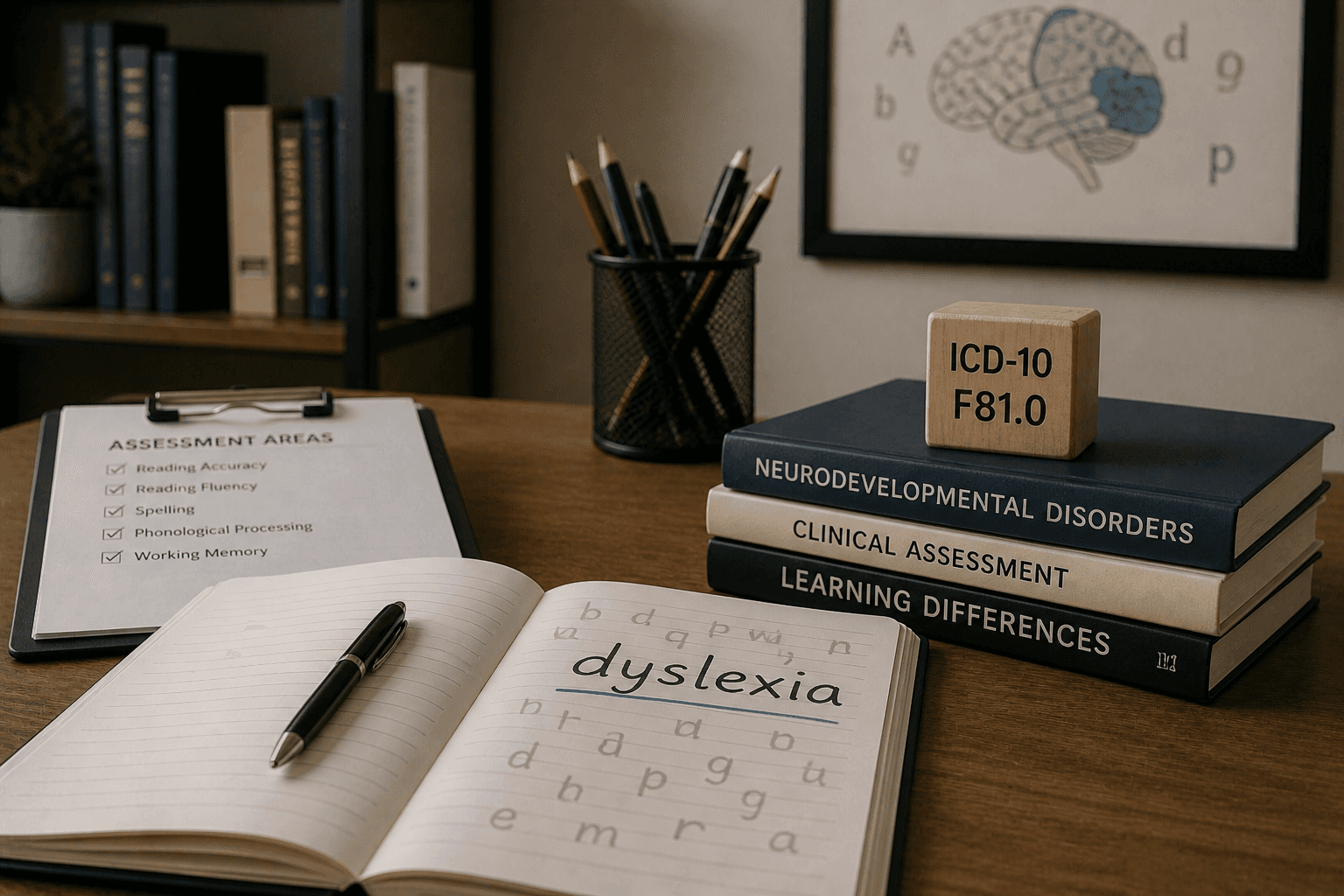
The ICD-10 code F81.0 (Specific reading disorder) captures this condition. But the code alone tells only a fraction of the story. This article moves beyond the "simple definition" to explore the neurobiological underpinnings, the differential diagnosis, the lifelong trajectory, and the clinical interventions that can transform a life of hidden struggle into one of self-understanding and empowerment.
The Code and Its Context — What F81.0 Represents
The ICD-10-CM diagnosis code F81.0 (Specific reading disorder) falls within the broader category F81 (Specific developmental disorders of scholastic skills) . It is a billable, specific code, effective for the 2026 fiscal year, and is used to capture developmental dyslexia—a neurobiological condition characterised by persistent difficulties with accurate and fluent word recognition, decoding, and spelling.
Inclusion terms for F81.0 include:
Specific reading retardation
Developmental dyslexia
Reading disorder
"Backward reading"
What this code excludes is as important as what it includes. F81.0 should not be used for:
Acquired dyslexia (R48.0) — reading loss following a neurological event such as stroke or traumatic brain injury
Intellectual disability (F70-F79) — where reading difficulties are part of a global cognitive impairment
Inadequate instruction (Z55.8) — where reading problems stem from a lack of educational opportunity, not a neurobiological difference
F81.0 is reserved for individuals who, despite adequate intelligence, appropriate schooling, and intact sensory abilities, exhibit a persistent and specific difficulty with reading.
Billing and coding context: As a billable code, F81.0 can be used for reimbursement of diagnostic assessments, psychological testing, and therapeutic interventions. However, payers typically require documentation of standardised testing, evidence of significant discrepancy between cognitive ability and reading achievement, and rule-out of other causes.
Seventy‑fifth character note: In the ICD-10-CM system, external cause codes require a seventh character extension (A for initial encounter, D for subsequent, S for sequela). F81.0, as a developmental diagnosis code, does not require such extensions. It is a static diagnosis that, once established, remains applicable across the lifespan.
The Neurobiological Reality — What Dyslexia Looks Like Inside the Brain
Dyslexia is not a visual problem. It is not a matter of reversing letters or seeing words backwards, though such symptoms may appear in young children. At its core, dyslexia is a phonological processing deficit—a difficulty in mapping the sounds of spoken language onto the visual symbols of written language.
Neuroimaging research has illuminated the neural signature of this difficulty. In typical readers, a small region of the left occipitotemporal cortex, known as the Visual Word Form Area (VWFA) , becomes highly active during reading tasks. This region acts as the brain's dedicated word recognition centre, rapidly and automatically processing strings of letters as unified word forms.
In individuals with dyslexia, the VWFA functions differently. A landmark 2026 study led by Stanford researcher Jason Yeatman found that the VWFA was detectable in nearly all typical readers but in fewer than two-thirds of children with dyslexia. Among those with a detectable VWFA, the region was, on average, smaller than in typical readers. Critically, the size of each child's VWFA correlated directly with reading ability—smaller region, weaker reading.
This is not a fixed deficit. The same study demonstrated that after eight weeks of intensive, evidence-based reading intervention, the VWFA could be detected in more children with dyslexia, and the region grew larger. The intervention was not merely improving behaviour; it was literally building the brain circuit.
In a separate 2024 study, Farah and colleagues tested an executive-function-based reading training program in one hundred twenty children. Using pre- and post-training functional magnetic resonance imaging (fMRI), they found that improved word reading was linked to stronger functional connections within and between sensory networks. The findings support the theory that dyslexia involves "neural noise"—inefficient, less synchronised neural signalling—and that effective intervention reduces that noise by promoting greater brain system synchronisation.
Emerging research even suggests that individuals with reading difficulties may be able to learn to upregulate VWFA activity using real-time fMRI neurofeedback, though such approaches remain experimental.
The clinical takeaway for psychotherapists: The adult who struggled silently through school, who developed elaborate workarounds and extraordinary effort to compensate, was not "lazy" or "not trying hard enough." Their brain was organised differently. Understanding this neurobiological basis is essential for reducing the profound shame that often accompanies undiagnosed dyslexia.
The Lifespan Trajectory — From Childhood Clues to Adult Compensation
Dyslexia does not disappear with age. While intervention can dramatically improve reading skills, the core phonological processing difference persists across the lifespan.
In early childhood (ages 4-7): Parents and teachers may notice:
Delayed speech development and difficulty rhyming
Trouble learning the letters of the alphabet
Persistent letter reversals (b/d, p/q) beyond age seven
Difficulty connecting letters to their sounds
In school-age children (ages 7-12): Academic demands intensify, and reading difficulties become more apparent:
Slow, laboured reading with poor prosody (the natural rhythm and intonation of speech)
Guessing at words based on initial letters rather than decoding
Avoidance of reading aloud
Spelling that is phonetically inaccurate and inconsistent
Strengths in areas not reliant on reading (oral comprehension, creativity, problem-solving)
In adolescence (ages 13-18): Compensatory strategies often develop:
Reliance on audiobooks and text-to-speech technology
Avoidance of courses requiring extensive reading
Anxiety about timed tests and reading aloud
Discrepancy between verbal intelligence and written expression
In adulthood (ages 18+): The hidden struggle often persists behind a façade of competence:
Slow reading speed that makes work tasks onerous
Difficulty with professional writing tasks
Avoidance of roles requiring substantial reading
Persistent shame and low self-esteem despite professional success
Secondary anxiety and depression resulting from a lifetime of perceived inadequacy
Why adult diagnosis is frequently missed: Many adults with dyslexia develop sophisticated compensatory strategies that mask their underlying difficulty. They may read slowly but accurately, putting in extraordinary effort that others do not see. They may avoid situations that expose their reading challenges. They may attribute their struggles to being "not a reader" or "not good with words."
The diagnostic assessment in adulthood must include a careful developmental history—reading difficulties present since elementary school, even if never formally diagnosed—and standardised testing that reveals the discrepancy between cognitive ability and reading achievement.
This discrepancy between measured intelligence and reading performance is a core diagnostic feature of Specific Reading Disorder (F81.0). The growing awareness and research on dyslexia have led to improved identification and support for schoolchildren, yet many adults with significant reading difficulties were missed by such systems, underscoring the need for adult diagnostic services.
The Differential Diagnosis — Distinguishing F81.0 from Other Conditions
Not every reading difficulty is dyslexia. Accurate diagnosis requires ruling out alternative explanations.
Condition | Distinguishing Features | Coding Implication |
|---|---|---|
Intellectual disability (F70-F79) | Reading difficulties are part of a global cognitive deficit affecting multiple domains. | F81.0 is not used when intellectual disability fully accounts for the reading problem. |
Acquired dyslexia (R48.0) | The patient previously read normally; reading loss occurred after a stroke, traumatic brain injury, or other neurological event. | Use R48.0, not F81.0. |
Inadequate instruction (Z55.8) | The child has never been exposed to evidence-based reading instruction, including explicit phonics. | This is an educational problem, not a disorder. |
ADHD (F90.-) | Attentional difficulties may secondarily impact reading. | Reading testing should be conducted when the child is optimally medicated to determine whether the primary deficit is attentional or phonological. |
Uncorrected sensory deficits (H54, H90, etc.) | Reading difficulty is explained by uncorrected vision or hearing loss. | Code the sensory impairment; F81.0 is not appropriate. |
The comorbidity with ADHD: The relationship between dyslexia and ADHD is bidirectional. Children with ADHD are approximately twice as likely to have dyslexia, and children with dyslexia are approximately twice as likely to meet criteria for ADHD. This means that any child diagnosed with one condition should be systematically screened for the other. Failure to identify both conditions leads to incomplete treatment and poor outcomes.
Documentation of rule-out: A defensible diagnostic note must explicitly state that sensory deficits, intellectual disability, inadequate instruction, and acquired conditions have been considered and excluded. Example: "No uncorrected vision or hearing deficits. Full-scale IQ within normal limits (FSIQ = 102). Educational records confirm consistent access to evidence-based reading instruction. No history of neurological event."
The Gold Standard of Psychological Testing
Diagnosis of F81.0 requires standardised, norm-referenced assessment conducted by a qualified professional—typically a licensed psychologist, neuropsychologist, or educational specialist. The diagnostic battery should include:
Cognitive assessment:
Wechsler Intelligence Scale for Children (WISC-V) or Wechsler Adult Intelligence Scale (WAIS-IV)
Assessment of verbal, perceptual, working memory, and processing speed indices
Academic achievement assessment:
Wechsler Individual Achievement Test (WIAT-IV)
Woodcock-Johnson Tests of Achievement (WJ-IV)
Key reading subtests: word reading, pseudoword decoding, reading fluency, reading comprehension, spelling
Phonological processing assessment:
Comprehensive Test of Phonological Processing (CTOPP-2)
Measures of phonological awareness, phonological memory, and rapid naming
Diagnostic threshold: A significant discrepancy between cognitive ability (IQ) and reading achievement—typically one to one and a half standard deviations (15–22 points)—is the classic diagnostic hallmark of specific reading disorder, though the most recent research emphasises a deficit in phonological processing as the core feature, with or without a significant IQ-achievement discrepancy.
When to refer for testing: Mental health professionals who suspect dyslexia but are not trained in psychoeducational assessment should refer to a psychologist or neuropsychologist. The referral should specify the reason for assessment (e.g., "Rule out specific learning disorder in reading"), provide relevant background information, and request that the report include ICD-10 diagnostic coding.
Evidence‑Based Interventions
The treatment of dyslexia is primarily educational, not medical or psychotherapeutic. The gold standard is structured literacy instruction—an approach that is explicit, systematic, cumulative, and multisensory.
Core components of structured literacy:
Phonemic awareness: Explicit teaching of the ability to identify and manipulate sounds in spoken words
Phonics: Systematic instruction linking letters (graphemes) to sounds (phonemes)
Fluency training: Repeated oral reading with corrective feedback
Vocabulary and comprehension strategies: Explicit instruction in understanding what is read
Evidence-based programs with strong research support include:
Orton-Gillingham and its derivatives (Wilson Reading System, Barton Reading Program)
Lindamood-Bell programs (LiPS, Seeing Stars)
Read Naturally (fluency-focused)
Assistive technology is essential for many individuals with dyslexia:
Text-to-speech software (e.g., Kurzweil, NaturalReader, built-in accessibility features)
Audiobooks (e.g., Learning Ally, Bookshare, Audible)
Speech-to-text software for writing
Optical character recognition (OCR) apps that read printed text aloud
The role of psychotherapy: Psychotherapy does not treat the reading deficit itself. However, it is essential for addressing the psychological consequences of a lifetime of undiagnosed dyslexia: shame, anxiety, depression, academic and workplace avoidance, and damaged self-esteem. The therapist's role includes:
Validating the patient's lifelong struggle
Educating about the neurobiological basis of dyslexia to reduce self-blame
Supporting the patient through the diagnostic process
Helping the patient advocate for accommodations in school or work
Treating comorbid anxiety and depression
No pharmacological treatment exists for dyslexia. Medications sometimes prescribed for ADHD may improve attention and thus support reading instruction, but they do not treat the core phonological deficit.
The Psychotherapist's Role — Beyond the Code
The mental health professional who suspects undiagnosed dyslexia in an adult patient occupies a unique and powerful position. You are not the dyslexia diagnostician—that role belongs to psychologists trained in psychoeducational assessment. But you are the one who recognises the pattern: the patient who dreads reading aloud, who avoids paperwork, who feels "stupid" despite evident intelligence, who has a long history of anxiety and low self-esteem that never quite responded to standard treatment.
Your role includes:
Screening for red flags:
"Do you avoid reading tasks at work or home?"
"How do you feel when asked to read aloud in a meeting?"
"When you read, do you feel that your eyes skip over words or that you have to re-read the same sentence multiple times?"
"How was reading for you in elementary school?"
Educating about the possibility of dyslexia:
Many adults with undiagnosed dyslexia have internalised decades of shame. The simple statement, "You know, dyslexia is not about intelligence, and it's not about not trying hard enough. It's a brain difference that makes reading hard work. I wonder if that might be part of what you've been experiencing," can be profoundly validating.
Facilitating referral for formal assessment:
Provide the patient with a list of psychologists or neuropsychologists who specialise in adult learning disorder assessment. Clarify that you are not making the diagnosis yourself but are recommending a comprehensive evaluation.
Providing emotional support throughout the process:
The diagnostic process can be emotionally charged, bringing up years of painful school memories. Be prepared to offer containment and support.
Integrating the diagnosis into ongoing therapy:
Once the diagnosis is confirmed, help the patient reframe their self-understanding. This is the core of the therapeutic work: shifting from "I am stupid" to "I have a brain that learns differently; I have a reading disorder, but I am intelligent and capable."
Advocating for reasonable accommodations:
Work with the patient to request accommodations in the workplace or in educational settings. These might include extended time on reading tasks, provision of written materials in advance, or access to text-to-speech technology.
Treating comorbid conditions:
Anxiety, depression, and social avoidance are common secondary consequences of undiagnosed dyslexia and must be addressed directly in therapy.
Documentation for F81.0
To support the diagnosis and justify billing for any related services (e.g., psychotherapy for emotional consequences), clinical documentation must be specific and evidence-based.
Essential elements for a diagnostic note:
Description of reading difficulties and their functional impact
Estimated age of onset (always childhood, even if the diagnosis is made in adulthood)
Results of standardised testing (must be attached or summarised)
Explicit statement that sensory deficits, intellectual disability, inadequate instruction, and acquired conditions have been ruled out
Description of the patient's response to the diagnosis (e.g., relief, validation, grief)
Sample diagnostic formulation for an adult:
"Patient, age 38, reports lifelong difficulty with reading speed and accuracy, present since first grade. She reports that reading is 'exhausting' and that she often avoids work tasks that require extensive reading. Her reading struggles have been a source of chronic shame and have contributed to her social anxiety and low self-esteem. Formal psychoeducational assessment completed by [Psychologist Name] on [Date] revealed a significant discrepancy between cognitive ability (FSIQ = 112, 79th percentile) and reading achievement (word reading standard score = 82, 12th percentile). Diagnosis: F81.0 Specific reading disorder (developmental dyslexia)."
Why documentation matters for reimbursement: If you are providing psychotherapy for the emotional consequences of dyslexia (anxiety, depression, shame), the diagnosis F81.0 should be included alongside the relevant F-code for the mental health condition (e.g., F41.1 for generalized anxiety disorder). The documentation must articulate the link between the dyslexia and the emotional symptoms: "Patient's anxiety is directly related to the fear of being asked to read in professional settings, a consequence of her undiagnosed dyslexia."
Conclusion
F81.0 is not merely a code. It is a key that unlocks a lifetime of hidden struggle and replaces self-blame with self-understanding. For the adult who has spent decades believing they were "stupid" or "lazy" or "not trying hard enough," the diagnosis of specific reading disorder is nothing short of transformative.
The mental health professional who recognises the signs of undiagnosed dyslexia, who validates the patient's struggle, who facilitates referral for assessment, and who supports the patient through the emotional aftermath of diagnosis, is not merely providing psychotherapy. They are rewriting a narrative that may have been written in shame decades ago.
The child who struggled to read is not the problem. The adult who hides their reading difficulties behind elaborate workarounds is not the problem. The problem is a system that failed to recognise a specific, neurobiological, treatable condition. The solution begins with accurate diagnosis—and the humble code F81.0.
FAQ
Is F81.0 the same as "dyslexia"?
Yes. F81.0 is the ICD-10-CM code for "Specific reading disorder," the diagnostic term that encompasses developmental dyslexia. The inclusion terms for F81.0 explicitly include both "developmental dyslexia" and "reading disorder." Synonyms used in different contexts include "specific reading retardation" and "backward reading."
Can adults be diagnosed with F81.0 if they were never identified as children?
Yes. Dyslexia is a lifelong condition. The diagnosis requires evidence that the reading difficulties were present in childhood, which can be established through retrospective report, review of old school records, or standardised testing that reveals the characteristic patterns. Many adults were never identified as children and are diagnosed for the first time in adulthood—often after their own child receives a diagnosis.
What is the difference between F81.0 and R48.0?
F81.0 is for developmental dyslexia—a neurobiological condition present from birth. R48.0 (Dyslexia and alexia, unspecified) is for acquired reading loss—dyslexia that develops after a neurological event such as a stroke or traumatic brain injury in a person who previously read normally. In clinical terms: always present? F81.0. Sudden onset after injury? R48.0.
Does F81.0 include comprehension difficulties?
The core deficit in F81.0 is in word recognition (decoding) and spelling, not comprehension. However, slow, effortful reading inevitably affects comprehension because the reader expends so much cognitive energy on decoding that little remains for understanding. Poor reading comprehension without evidence of decoding or phonological deficits would suggest a different diagnosis, possibly a language disorder.
How can I, as a therapist without psychological testing training, help a patient who I suspect has dyslexia?
Your role is not to diagnose but to recognise, validate, educate, and refer. Listen for the red flags: reading avoidance, slow reading speed, shame about reading aloud, discrepancy between verbal intelligence and written output. Validate the patient's struggle without judgment. Educate about the neurobiological basis of dyslexia to reduce self-blame. And refer to a qualified psychologist or neuropsychologist for formal assessment. Once the diagnosis is established, your role expands to include emotional processing, self-concept repair, and support for accommodations.
References
If you’re ready to spend less time on documentation and more on therapy, get started with a free trial today
Not medical advice. For informational use only.
Outline
More articles