
Apr 21, 2026
A patient sits in your office. She describes a crushing, bone‑deep exhaustion that no amount of sleep relieves. She has cancelled social plans, struggled to complete work tasks, and feels like her body is made of lead. She has seen three primary care physicians, undergone countless blood tests, and been told that "all her labs are normal."
You reach for your diagnosis codes. Which one fits? R53.83 (Other fatigue)? R53.82 (Chronic fatigue, unspecified)? G93.32 (Myalgic encephalomyelitis/chronic fatigue syndrome)? Or is the fatigue secondary to something else — depression (F32.9), a sleep disorder (G47.9), a side effect of medication? The answer determines not just the code on the claim form, but the entire trajectory of treatment.
Fatigue is among the most common presenting complaints in both primary care and mental health settings. It cuts across every diagnostic category — medical, neurological, psychiatric, and idiopathic. Yet it is also among the most poorly coded and most frequently misunderstood symptoms in clinical practice. A therapist who treats “fatigue” as a monolithic entity will miss the nuances of neurobiology that distinguish ordinary tiredness from pathological exhaustion.
This article provides a comprehensive clinical guide to the ICD‑10 coding of fatigue. It goes beyond the simple description of codes to explore the neurobiological underpinnings, the differential diagnosis across medical and psychiatric conditions, and the documentation strategies that protect your practice while serving your patients.
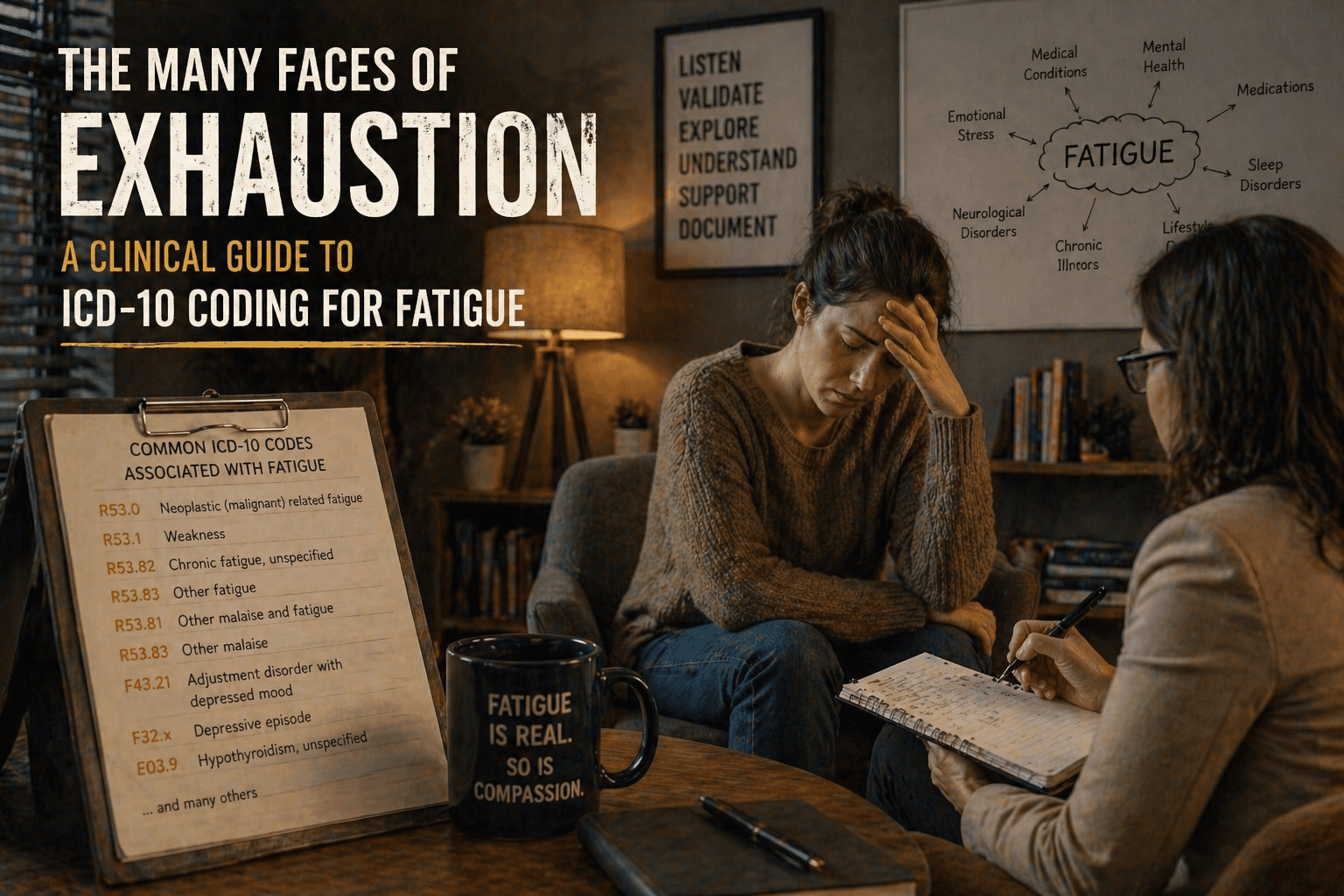
The Code Landscape — Navigating the Fatigue Family
Fatigue is not a single code; it is an entire family of codes, each with distinct clinical requirements and implications for treatment.
The R53 Family: Malaise and Fatigue
The primary home for fatigue coding is the R53 category: Malaise and fatigue. Within this category lie several subcodes, each requiring careful clinical discrimination.
R53.83 – Other fatigue is the most commonly used code for generalized, short‑term fatigue without a definitive diagnosis. It is applicable for fatigue that has not persisted for more than six months and is not linked to a specific underlying condition. Documentation for R53.83 should include the duration and severity of fatigue, as well as evidence that other causes (anaemia, thyroid disorders, depression) have been considered and ruled out. Synonyms for R53.83 include lack of energy, lethargy, and tiredness. The code is appropriate when fatigue is unexplained and impacts daily activities for less than six weeks.
R53.82 – Chronic fatigue, unspecified is used when chronic fatigue is present but does not meet the specific diagnostic criteria for myalgic encephalomyelitis/chronic fatigue syndrome (ME/CFS). This code is appropriate for patients who have experienced debilitating, long‑term fatigue for more than six months but do not exhibit the full picture of ME/CFS — specifically, the absence of post‑exertional malaise, cognitive impairment, or orthostatic intolerance.
R53.0 – Neoplastic (malignant) related fatigue is a billable code that applies when fatigue is directly connected to a cancer diagnosis or its treatment. This code cannot stand alone; the instructional note requires the coder to code first the associated neoplasm. Distinguishing R53.0 from R53.83 is critical: if fatigue is due to the cancer itself, R53.0 is appropriate; if fatigue is a side effect of chemotherapy, R53.83 (Other fatigue) should be used instead, followed by the code for adverse effect of antineoplastic agents.
R53.1 – Weakness (generalized weakness) should be used when weakness — the subjective sensation of reduced muscle power — is the primary complaint, rather than fatigue, which is a sense of sustained exhaustion independent of muscular effort.
R53.81 – Other malaise captures a vague sense of bodily discomfort or feeling unwell — a less specific symptom than fatigue. It is appropriate when malaise is the primary complaint and fatigue is not the dominant feature.
The G93.3 Family: Postviral and Related Fatigue Syndromes
For fatigue that follows an infection or meets ME/CFS criteria, codes from the G93.3 category (Postviral and related fatigue syndromes) are appropriate.
G93.32 – Myalgic encephalomyelitis/chronic fatigue syndrome (ME/CFS) is a specific, billable code introduced in October 2022. Prior to this update, ME/CFS was incorrectly grouped under the nonspecific R53.82, causing confusion for providers, patients, and researchers. The new code requires that the patient meet CDC diagnostic criteria for ME/CFS, including profound, disabling fatigue lasting more than six months, post‑exertional malaise, unrefreshing sleep, and either cognitive impairment or orthostatic intolerance.
G93.31 – Postviral fatigue syndrome is used when fatigue persists for more than six months after a confirmed viral illness. This code is particularly relevant in the context of long COVID, where persistent fatigue is a common symptom.
G93.39 – Other post infection and related fatigue syndromes captures post‑infection fatigue syndromes that do not meet the specific criteria for postviral fatigue syndrome.
T67.6 – Heat fatigue, transient
This non‑billable code captures acute, situational tiredness due to heat exposure. It is not a mental health code and is not relevant for outpatient psychotherapy.
F48.0 – Neurasthenia
Neurasthenia — a diagnosis that has fallen out of favour in many clinical settings — is characterised by fatigue or exhaustion after minimal mental or physical effort. Symptoms may include muscle aches, headaches, irritability, and difficulty relaxing. In the ICD‑10, neurasthenia is classified under “Neurotic, stress‑related and somatoform disorders” (F48.0). It is an alternative to R53 codes when the fatigue is not attributable to a medical condition and is accompanied by marked subjective distress.
Excludes1 Notes: What Cannot Be Coded Together
Accurate coding requires awareness of the “Excludes1” notes attached to each fatigue code:
R53.83 (Other fatigue) excludes fatigue due to depressive disorders and pregnancy‑related fatigue.
G93.3 (Postviral and related fatigue syndromes) explicitly excludes chronic fatigue NOS (R53.82) and neurasthenia (F48.8).
R53.0 (Neoplastic related fatigue) excludes R53.1 (Postviral fatigue syndrome) and F32.9 (Depressive disorder).
These exclusions are not arbitrary; they reflect the clinical reality that fatigue must be properly attributed to its underlying cause, not blindly coded as a symptom.
The Neurobiological Reality — When Fatigue Is Not “All in Your Head”
For decades, chronic fatigue and ME/CFS were dismissed as psychological conditions. The prevailing narrative — that patients were suffering from “somatisation” or “illness anxiety” — caused immeasurable harm and delayed the development of effective treatments.
The research has since exploded that myth.
Advances in research have evolved our understanding of ME/CFS, with evidence now clearly showing that the basis of the condition is biomedical rather than psychological, with multi‑systemic dysfunction driving pathogenesis and symptom progression. The Institute of Medicine (2015) Criteria are now the preferred diagnostic criteria for ME/CFS, and international guidelines from institutions like the Mayo Clinic, the CDC, and NICE provide an up‑to‑date framework for healthcare professionals.
Central to the biology of ME/CFS is the phenomenon of post‑exertional malaise (PEM) – a cardinal symptom in which even minor physical or cognitive exertion produces a disproportionately severe worsening of symptoms that can last for days or weeks. This is not ordinary tiredness after exercise; it is a pathological, delayed, and prolonged response to exertion that reflects underlying mitochondrial dysfunction, immune dysregulation, and metabolic abnormalities.
Pacing — a free energy management technique — is the focus of treatment, as ignoring these guidelines can worsen a patient’s condition. Importantly, robust reviews of the evidence have led to the removal of three previously recommended treatments from international guidelines: Cognitive Behavioural Therapy (CBT) as a treatment for the underlying illness, Graded Exercise Therapy (GET), and the Lightning Process. Continuing to prescribe these treatments may cause harm.
For the psychotherapist, this research has profound implications. A patient whose fatigue meets ME/CFS criteria does not need CBT to challenge “catastrophic beliefs” about their illness. They do not need to be told to push through the fatigue with graded exercise. They need validation, pacing support, and referral to specialists who understand the biomedical basis of the condition. Psychotherapy has a role — but it is a supportive role, focused on coping with a chronic illness, not curing it.
In 2025, the German Federal Institute for Drugs and Medical Devices (BfArM) introduced new five‑character codes to distinguish post‑infectious and non‑post‑infectious forms of ME/CFS. The landscape is shifting rapidly toward more precise, biologically grounded classification.
The Differential Diagnosis Dilemma — When Fatigue Hides Depression
One of the most common diagnostic errors in mental health practice is the assumption that fatigue automatically indicates depression.
Fatigue is indeed a core neurovegetative symptom of major depressive disorder. The diagnostic criteria for MDD (F32.x, F33.x) include “fatigue or loss of energy nearly every day” as one of the nine criterion symptoms. In practice, many clinicians encountering a patient with unexplained fatigue will default to F32.9 – Major depressive disorder, single episode, unspecified.
This is often wrong — and sometimes dangerously so.
CFS goes undiagnosed in 80% of cases and is often misdiagnosed as depression. The overlap in symptoms is substantial: both conditions involve fatigue, sleep disturbance, cognitive complaints, and reduced activity. However, the underlying mechanisms and appropriate treatments are entirely different.
Key differentiating features include:
Activity response: In depression, activity often improves mood and energy (behavioural activation). In CFS/ME, activity triggers post‑exertional malaise — a delayed, prolonged worsening of symptoms.
Sleep quality: In depression, sleep is often disturbed but may feel restorative after a good night. In ME/CFS, sleep is unrefreshing regardless of duration.
Motivation: In depression, lack of motivation is central (avolition). In ME/CFS, motivation is intact; the patient wants to engage but cannot without triggering PEM.
Cognitive symptoms: In depression, cognitive complaints (poor concentration, memory difficulties) are often mood‑congruent. In ME/CFS, cognitive impairment (“brain fog”) is a primary, disabling feature that worsens with exertion.
From a coding perspective, the distinction matters enormously. Using F32.9 for a patient who has ME/CFS leads to inappropriate treatment (antidepressants, CBT aimed at restructuring beliefs about fatigue, graded exercise) that may actively harm the patient. Conversely, using G93.32 for a patient whose fatigue is a symptom of a major depressive episode may deprive them of the antidepressant treatment that could resolve their symptoms.
Neurotic, stress‑related and somatoform disorders – including neurasthenia (F48.0) – occupy a middle ground, capturing cases where fatigue is not attributable to a medical condition but is not clearly part of a primary mood disorder either.
A systematic approach to differential diagnosis should include:
Medical workup (thyroid function, complete blood count, ferritin, vitamin B12, vitamin D)
Sleep assessment (rule out sleep apnoea, insomnia)
Medication review (antidepressants, beta‑blockers, antihistamines, etc)
Functional assessment (how does the patient respond to exertion? What makes the fatigue worse or better?)
ME/CFS screening using validated tools

Special Populations — Fatigue Across the Lifespan and Clinical Contexts
Cancer‑Related Fatigue (R53.0)
Fatigue is among the most common symptoms reported by cancer patients, yet it is frequently under‑coded and undertreated. The etiological ambiguity is a persistent coding challenge: is the fatigue due to the malignancy itself, or to the treatment the patient is receiving?
If the provider determines that the fatigue is due to the cancer, R53.0 (Neoplastic related fatigue) is appropriate, with the associated neoplasm coded first. If the fatigue is due to chemotherapy, R53.83 (Other fatigue) is used, followed by the code for the adverse effect of the drug — T45.1X5 (Adverse effect of antineoplastic and immunosuppressive drugs) — plus a seventh character as appropriate.
Coding for cancer‑related fatigue becomes more complex when anaemia is also present. If the provider documents anaemia due to the cancer, D63.0 (Anaemia in neoplastic disease) is coded, with the neoplasm first, followed by R53.0. If the anaemia is due to chemotherapy, D64.81 (Anemia due to antineoplastic chemotherapy) is used, with the adverse effect code for the chemotherapy drug, followed by the fatigue code.
Post‑COVID Fatigue and Long COVID
The COVID‑19 pandemic has brought post‑viral fatigue into sharp focus. For patients whose fatigue persists after a confirmed SARS‑CoV‑2 infection, G93.31 (Postviral fatigue syndrome) is the appropriate code. When coding for post‑COVID conditions, the code U09.9 (Post COVID‑19 condition, unspecified) should be added to indicate the link to COVID‑19.
The 2026 ICD‑10‑CM codes now direct coders to use U09.9 for post‑COVID condition when appropriate, making it clearer when ME/CFS occurs following SARS‑CoV‑2 infection.
Paediatric Fatigue
Fatigue in children and adolescents is frequently overlooked or dismissed as “growing pains” or “school refusal.” The diagnostic criteria for ME/CFS in children require fatigue lasting more than three months (rather than six months for adults), with the same core features of PEM, unrefreshing sleep, and cognitive impairment. Paediatric fatigue should trigger a thorough medical and psychiatric assessment, with careful attention to school avoidance and social withdrawal, which may be consequences of the fatigue rather than primary psychological problems.
Fatigue in the Elderly
In older adults, fatigue is often misattributed to “normal ageing.” Pathological fatigue is not a normal part of aging. Elderly patients presenting with fatigue should be evaluated for anaemia, thyroid dysfunction, sleep apnoea, medication side effects, depression, and early neurodegenerative disease. The coding choice — R53.83 for unexplained fatigue, G93.32 for ME/CFS, or a secondary fatigue code linked to the underlying medical condition — will vary based on the workup findings.
Clinical Documentation — What Auditors Look For
To justify medical necessity for fatigue‑related diagnoses — and to avoid claim denials and audits — clinical documentation must be specific, evidence‑based, and defensible.
Unlike many psychiatric diagnoses, fatigue codes require documentation of objective data or structured assessment. This is especially true for cancer‑related fatigue (R53.0), which requires evidence linking fatigue to the neoplasm or its treatment, and for G93.32, which requires explicit documentation of CDC diagnostic criteria for ME/CFS.
For R53.83 (Other fatigue):
Essential documentation includes:
Fatigue score >4/10 on the FACIT‑F (Functional Assessment of Chronic Illness Therapy – Fatigue) scale
Normal TSH (0.4‑4.0 mIU/L) and haemoglobin levels (>12 g/dL) to rule out common organic causes
No improvement after a two‑week trial of activity modification
Specific description of how fatigue impacts daily activities (e.g., “unable to complete work tasks,” “cancelled social plans three times in two weeks”)
For R53.82 (Chronic fatigue, unspecified):
Essential documentation includes:
Fatigue duration >6 weeks
Epworth Sleepiness Scale score >10
Negative polysomnography to rule out sleep disorders
Exclusion of ME/CFS criteria
For G93.32 (ME/CFS):
Essential documentation must explicitly reference CDC diagnostic criteria, including:
Fatigue lasting >6 months with profound functional impairment
Post‑exertional malaise (PEM) – the cardinal feature
Unrefreshing sleep
Cognitive impairment or orthostatic intolerance
For R53.0 (Neoplastic related fatigue):
Essential documentation includes:
Clear linkage of fatigue to the malignancy or its treatment
Cancer diagnosis (coded first)
Severity and impact on daily activities
General documentation best practices
Implementing a standardised fatigue assessment in your practice — using the Fatigue Assessment Scale (FAS) or the FACIT‑F — can help quantify the level of fatigue and support your coding choices.
Documentation should also explicitly address rule‑outs: “Thyroid studies within normal limits,” “Anaemia ruled out,” “No evidence of major depressive episode (PHQ‑9 = 4).” The auditor must see that alternative causes have been considered and excluded before a symptom code is assigned.
Poor documentation (“patient tired”) is a red flag for auditors. Good documentation (“patient reports fatigue rated 7/10 interfering with work and social functioning for 3 months; TSH normal; Hb normal; EPS >10; no ME/CFS criteria”) supports medical necessity and justifies treatment.
Clinical Vignettes — Applying the Codes
Vignette 1: The cancer patient on chemotherapy
A 55‑year‑old woman with breast cancer (C50.9) is receiving adjuvant chemotherapy. She reports exhaustion that began after her second cycle of treatment. She has no evidence of anaemia. Her oncologist documents the fatigue as chemotherapy‑induced.
Coding: R53.83 (Other fatigue) as the condition being treated, plus T45.1X5‑ (Adverse effect of antineoplastic and immunosuppressive drugs) with appropriate seventh character (A, D, or S), plus the neoplasm code (C50.9) if addressed.
Vignette 2: The patient with chronic fatigue but not ME/CFS
A 42‑year‑old woman reports severe fatigue for eight months. She has no post‑exertional malaise; her sleep, though disrupted, is occasionally refreshing. Cognitive complaints are minimal. She does not meet CDC criteria for ME/CFS.
Coding: R53.82 (Chronic fatigue, unspecified).
Vignette 3: The patient with ME/CFS
A 35‑year‑old man reports disabling fatigue for three years. Every time he exerts himself — even a short walk — he experiences a severe worsening of symptoms that lasts for days. He wakes feeling unrefreshed, and he describes his thinking as “foggy” and slow. He meets CDC criteria for ME/CFS.
Coding: G93.32 (Myalgic encephalomyelitis/chronic fatigue syndrome).
Vignette 4: The patient with fatigue due to depression
A 28‑year‑old man reports low mood, anhedonia, and fatigue for six months. He sleeps excessively but feels tired anyway. His PHQ‑9 score is 18. He has no PEM; physical exertion, when he can manage it, improves his mood temporarily.
Coding: F32.9 (Major depressive disorder, single episode, unspecified). Fatigue is a symptom of the depression, not a separate code.
Vignette 5: The patient with unexplained short‑term fatigue
A 30‑year‑old woman reports fatigue for three weeks. She has no other symptoms. Blood work is normal. She reports that the fatigue is impacting her ability to keep up with her children and perform her job.
Coding: R53.83 (Other fatigue), with documentation that other causes have been ruled out and that the fatigue is short‑term (<6 weeks).
Conclusion
Fatigue is never just fatigue. It is a symptom that sits at the intersection of neurology, psychiatry, internal medicine, and idiopathic illness. The ICD‑10 code you assign reflects not merely a billing choice but a diagnostic formulation — a statement about what you believe is causing your patient’s suffering and what treatment is therefore appropriate.
When a patient in your office says, “I am so tired,” your job is not to reach for a single code. Your job is to ask: tired how? Tired for how long? Tired in what context? Tired with what accompanying features? The answers will guide you — through the R53 family, the G93.3 category, the F48.0 diagnosis, or the F32.9 code for depression.
The exhaustion may be a signal of a neuroinflammatory process, a post‑viral sequela, a side effect of chemotherapy, a symptom of a mood disorder, or an idiopathic condition with a biomedical basis. Your ability to navigate this landscape — to document thoroughly, to code precisely, and to advocate for appropriate treatment — is not a bureaucratic necessity. It is a clinical responsibility and an ethical imperative.
The tired patient deserves better than a checkbox. They deserve a clinician who understands what the codes really mean.
FAQ
What is the difference between R53.82 (Chronic fatigue, unspecified) and G93.32 (ME/CFS)?
R53.82 is for chronic fatigue lasting more than six months that does not meet the specific diagnostic criteria for ME/CFS. G93.32 is reserved for patients who meet CDC criteria, including the cardinal symptom of post‑exertional malaise (PEM) — a delayed, prolonged worsening of symptoms after even minor exertion. R53.82 should be used when the full clinical picture of ME/CFS is not present.
How do I choose between R53.83 (Other fatigue) and R53.0 (Neoplastic related fatigue)?
R53.83 is for general, unexplained short‑term fatigue (<6 weeks) without a clear underlying cause. R53.0 is specific to fatigue directly linked to a cancer diagnosis. If the fatigue is due to the malignancy itself, use R53.0 with the neoplasm coded first. If the fatigue is due to chemotherapy (side effect), use R53.83 followed by the adverse effect code T45.1X5‑.
Can I code fatigue as a primary diagnosis for insurance reimbursement?
Generally, no. Symptoms and signs codes from Chapter 18 (R00‑R99) should not be used as principal or first‑listed diagnoses if the underlying cause is known. If fatigue is the only presenting complaint and no underlying cause is identified after thorough workup, a symptom code (R53.83) may be appropriate as a primary diagnosis. However, in most mental health contexts, fatigue is a symptom of another condition (depression, anxiety, sleep disorder), and the underlying condition should be coded first.
How do I document fatigue to support medical necessity?
Document the nature, duration, severity, and functional impact of the fatigue. Use standardised assessment tools (FAS, FACIT‑F) to quantify the severity. Explicitly rule out common organic causes (anaemia, thyroid dysfunction). For chronic fatigue, document the duration (>6 months) and the presence or absence of ME/CFS features (PEM, unrefreshing sleep, cognitive impairment). The more specific your documentation, the stronger your justification for treatment.
What is the role of psychotherapy in treating ME/CFS?
Psychotherapy has a supportive, not curative, role in ME/CFS. International guidelines recommend symptom‑oriented, individualised therapeutic approaches that integrate somatic, social, and psychological factors. Activating treatment approaches such as graded exercise therapy (GET) are generally viewed critically in connection with post‑exertional malaise, and robust reviews have led to the removal of CBT for the underlying illness, GET, and the Lightning Process from international guidelines. Psychotherapy can help patients cope with the emotional impact of a chronic, disabling illness, but it is not a treatment for the underlying pathophysiology.
References
ICD-10 Data. (2026). 2026 ICD-10-CM Diagnosis Code R53.83: Other fatigue.
ICD-10 Data. (2026). 2026 ICD-10-CM Diagnosis Code R53.82: Chronic fatigue, unspecified.
ICD-10 Data. (2026). 2026 ICD-10-CM Diagnosis Code R53.0: Neoplastic (malignant) related fatigue.
ICD-10 Data. (2026). 2026 ICD-10-CM Diagnosis Code G93.3: Postviral and related fatigue syndromes.
ICD-10 Data. (2026). 2026 ICD-10-CM Diagnosis Code T67.6: Heat fatigue, transient.
ICDcodes.ai. (2026). Fatigue – ICD-10 Documentation Guidelines.
ICDcodes.ai. (2025). Lack of energy – ICD-10 Documentation Guidelines.
ICDcodes.ai. (2025). Cancer-related fatigue – ICD-10 Documentation Guidelines.
If you’re ready to spend less time on documentation and more on therapy, get started with a free trial today
Not medical advice. For informational use only.
Outline
More articles