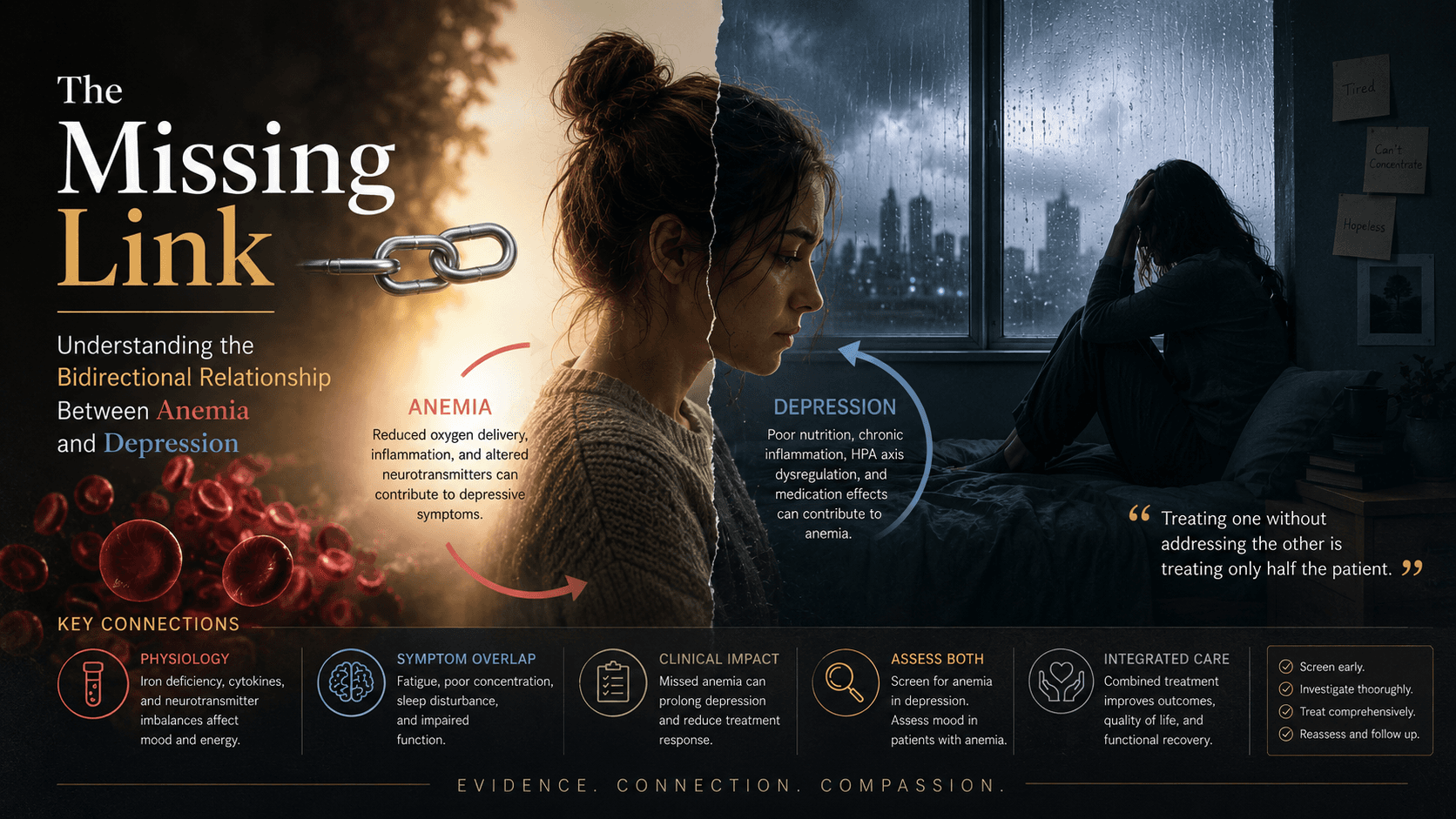
The Missing Link: Understanding the Bidirectional Relationship Between Anemia and Depression

May 13, 2026
For the clinician, few diagnostic puzzles are as confounding as the patient who presents with classic depressive symptoms—fatigue, anhedonia, difficulty concentrating, psychomotor slowing—yet fails to respond to standard antidepressant treatment. The patient attends sessions faithfully, completes homework assignments, and seems genuinely engaged. Yet the PHQ‑9 scores barely budge.
The answer may not lie in the patient’s psyche, but in their blood.
Anemia, particularly iron deficiency anemia (IDA), produces a symptom profile that is virtually indistinguishable from major depressive disorder: persistent fatigue, low energy, irritability, poor concentration, sleep disturbances, and a pervasive sense of exhaustion that no amount of rest can relieve. A large 2020 study in BMC Psychiatry found that people with IDA had a significantly higher incidence and risk of anxiety disorders, depression, sleep disorders, and psychotic disorders compared to those without IDA. Yet in routine mental health practice, the possibility that low hemoglobin or iron deficiency might be driving—or at least contributing to—a patient’s depressive symptoms is often overlooked.
This article examines the bidirectional relationship between anemia and depression, the neurobiological mechanisms that link them, the ICD‑10 coding framework for documenting both conditions, and the clinical protocols that can prevent misdiagnosis and improve treatment outcomes. For the practicing mental health professional, understanding anemia is not optional; it is an essential component of responsible, whole‑person care.
The Scope of the Problem — Why This Matters in Mental Health
Anemia is not a niche concern. Globally, iron deficiency is one of the most common nutrient deficiencies, affecting an estimated 25 percent of people worldwide. One out of every five women of childbearing age has iron‑deficiency anemia. In the United States, approximately 13 percent of adults over 12 report taking an antidepressant, yet many of those prescriptions may be addressing a symptom whose root cause is nutritional rather than psychiatric.
Depression and anemia share a constellation of symptoms that makes differentiation exceptionally challenging: fatigue is a hallmark of both conditions; cognitive complaints (poor concentration, “brain fog”) appear in both; sleep disturbances occur in both; and psychomotor slowing can be indistinguishable. A patient with chronic sinusitis or iron deficiency anemia can present with symptoms of depression and even satisfy the full diagnostic criteria. The clinician who treats only the psychiatric symptoms while ignoring the underlying medical condition risks prescribing medications that will be, at best, partially effective.
The relationship between anemia and depression is bidirectional. Depression can cause anemia through inflammatory pathways and nutritional neglect; anemia can cause depression through oxygen deprivation and neurotransmitter disruption; and both can be driven by a common underlying factor, such as chronic disease or nutritional deficiency. This complexity demands a systematic, diagnostically disciplined approach.
The Neurobiology — How Anemia Affects the Brain
The connection between low iron and depression is not speculative; it is grounded in well‑established neurobiology.
Iron is essential for the production of hemoglobin, the protein that enables red blood cells to carry oxygen to tissues and muscles. When iron levels are low, less oxygen reaches cells, impairing their function and leading to fatigue, weakness, and—critically—disrupted brain function. The brain’s demand for oxygen is exceptionally high; even modest reductions in oxygen delivery can alter neurotransmitter synthesis, neuronal firing, and cognitive processing.
At the molecular level, neuro‑bioavailability and brain capture of blood iron are necessary for the appropriate synthesis of three key neurotransmitters: serotonin, dopamine, and noradrenaline. These monoamines, which are central to the classical theory of depression, depend on neuronal aromatic hydroxylases that require iron as an essential cofactor. When brain iron levels fall, the production of these neurotransmitters is directly impaired, producing a clinical picture that mirrors endogenous depression.
Compounding this, anemia and depression are both associated with chronic inflammation. Chronic inflammation disrupts red blood cell production and can trigger neuroinflammation that affects the very neurotransmitter systems—serotonin and dopamine pathways—implicated in depression. Depression, in turn, is associated with irregularities in these same neurotransmitters, which also have implications for erythropoiesis and iron metabolism. The dysregulation of the HPA axis in depression results in heightened cortisol levels, which affects erythropoiesis and iron metabolism, thereby contributing to anemia.
The result is a vicious cycle: anemia impairs neurotransmitter synthesis → depressive symptoms appear → HPA axis dysregulation further impairs iron metabolism → anemia worsens → depressive symptoms deepen. Breaking this cycle requires addressing both the psychiatric symptoms and the underlying hematologic condition.
The Diagnostic Protocol — Screening for Anemia in Mental Health Practice
Given the symptom overlap and the bidirectional relationship between anemia and depression, routine laboratory screening should be a standard component of the initial psychiatric evaluation.
The American College of Physicians recommends a complete blood count (CBC) to screen for anemia, infection, or other hematologic abnormalities in patients presenting with depression. Beyond the CBC, a comprehensive laboratory panel should include:
Iron studies (serum iron, ferritin, total iron‑binding capacity, transferrin saturation)
Vitamin B12 and folate levels, as deficiencies in these nutrients can cause both anemia and mood disturbances
Thyroid function tests (TSH, free T4, free T3) to rule out thyroid dysfunction, which can mimic or exacerbate depression
Basic metabolic panel to rule out electrolyte disturbances, renal dysfunction, or glucose abnormalities that might contribute to depressive symptoms
Liver function tests to rule out hepatic dysfunction, which can also present with depressive symptoms
The key clinical principle is that depression screening is only effective when followed by accurate diagnosis, appropriate treatment, and—crucially—ruling out medical mimics. A patient who meets PHQ‑9 criteria for major depression but has a hemoglobin level of 9 g/dL may not have primary major depressive disorder at all; they may have secondary depression due to anemia. The treatment, in such a case, is iron supplementation, not an SSRI.
Even in cases where a patient clearly meets criteria for a primary depressive disorder, coexisting anemia must be identified and treated. Uncorrected anemia reduces the likelihood of response to antidepressant medication, prolongs the course of illness, and contributes to persistent fatigue that undermines engagement in psychotherapy.
The ICD‑10 Coding Framework for Anemia and Depression
Accurate coding of the relationship between anemia and depression requires a clear understanding of the ICD‑10 hierarchy and the rules for sequencing primary and secondary diagnoses.
Primary vs. Secondary Relationships
The coding rule depends on the clinical relationship between the two conditions:
If anemia is causing the depressive symptoms (depression secondary to anemia), the primary diagnosis is the anemia code, with the depressive syndrome coded as a secondary manifestation of the underlying medical condition. The appropriate code for this scenario is F06.8 (Other specified mental disorders due to known physiological condition) , which is specifically designated for mental disorders caused by known physiological conditions, including anemia. The anemia code (D50.x, D51.x, D52.x, etc.) is sequenced first, followed by F06.8.
If depression is causing the anemia (e.g., through nutritional neglect or via inflammatory pathways), the primary diagnosis is the depressive disorder (F32.x, F33.x, etc.), with the anemia code sequenced secondarily as a manifestation of the psychiatric condition.
If the two conditions are unrelated, separate codes may be assigned without a hierarchical relationship. The CDC guidelines state that if dizziness is not a component of a mental health condition, separate codes may be assigned for both. The same principle applies to anemia.
If both conditions are present but the relationship is unclear, the safest approach is to code both conditions and document the diagnostic uncertainty, with a plan for further evaluation.
ICD‑10 Codes for Anemia
The primary ICD‑10 codes for anemia relevant to mental health practice include:
Anemia Type | ICD‑10 Code | Clinical Context |
|---|---|---|
Iron deficiency anemia, unspecified | D50.9 | Most common form; often associated with fatigue, cognitive slowing, and depressive symptoms |
Iron deficiency anemia secondary to blood loss (chronic) | D50.0 | Menorrhagia, gastrointestinal bleeding |
Other iron deficiency anemias | D50.8 | Includes nutritional iron deficiency |
Vitamin B12 deficiency anemia | D51.x | Pernicious anemia; associated with cognitive impairment and mood disturbances |
Folate deficiency anemia | D52.x | Often related to poor nutrition or malabsorption |
Other deficiency anemias | D53.x | Includes protein‑deficiency anemia |
In a 2021 comorbidity study, deficiency anemia was coded as D50.8 and D50.9, while blood loss anemia was coded as D50.0.
ICD‑10 Codes for Depression
The ICD‑10 codes for depression span a range of severities and clinical contexts:
Depression Type | ICD‑10 Code | Clinical Context |
|---|---|---|
Major depressive disorder, single episode, mild | F32.0 | Few symptoms, mild functional impairment |
Major depressive disorder, single episode, moderate | F32.1 | Several symptoms, moderate impairment |
Major depressive disorder, single episode, severe without psychotic symptoms | F32.2 | Most symptoms, severe impairment |
Major depressive disorder, single episode, unspecified | F32.9 | Default code when severity not specified |
Major depressive disorder, recurrent, unspecified | F33.9 | ≥2 episodes; most common code in this family |
Dysthymic disorder | F34.1 | Chronic, low‑grade depression lasting ≥2 years |
Z‑Codes for Context
Z‑codes (Chapter 21) capture the psychosocial context of illness and can be invaluable when documenting patients whose depressive symptoms are intertwined with nutritional deficiencies. For a patient who is depressed and anemic due to food insecurity, Z59.4 (Inadequate housing) or Z59.6 (Low income) may be appropriate secondary codes. For a patient whose anemia is medication‑induced, Z79.899 (Other long‑term (current) drug therapy) may be used.
The key documentation principle is that the code must reflect the clinical reality. Auditors are trained to detect mismatches between the coded diagnosis and the documented clinical picture. A patient with profound fatigue, cognitive slowing, and a hemoglobin level of 8 g/dL who is coded only as F32.9 without mention of the anemia will trigger scrutiny.
Clinical Management — Treating the Whole Patient
The treatment of a patient with both anemia and depression requires an integrated, multidisciplinary approach that addresses both the psychiatric symptoms and the underlying medical condition.
Step 1: Confirm the Diagnosis and Identify the Cause
Before initiating treatment, confirm that the patient meets diagnostic criteria for a depressive disorder (if that is the primary diagnosis) and that anemia is present on laboratory testing. Identify the cause of the anemia: is it nutritional (iron, B12, folate deficiency), blood loss (menorrhagia, gastrointestinal bleeding), chronic disease (inflammation), or medication‑induced?
Step 2: Treat the Anemia
Iron supplementation is the first‑line treatment for IDA. A meta‑analysis of 18 trials found that iron supplementation improved self‑reported fatigue, even when objective activity measures did not change. Oral iron is effective in reducing fatigue in menstruating women with low ferritin or mild anemia. Dietary and supplemental iron improve vitality and mental well‑being in women of childbearing age. In cases of severe IDA or intolerance to oral iron, IV iron (e.g., ferric carboxymaltose) increases hemoglobin and reduces fatigue.
For B12 deficiency anemia, intramuscular or high‑dose oral B12 replacement is indicated. For folate deficiency anemia, folic acid supplementation is required.
Step 3: Monitor Response
Following treatment of anemia, depressive symptoms should be reassessed. In many cases, the “depression” resolves entirely once the underlying anemia is corrected, and no psychiatric diagnosis remains. In other cases, depressive symptoms persist even after hematologic normalization, indicating that the patient has both a primary depressive disorder and a comorbid anemia.
Step 4: Treat the Depression
For patients with primary depression (or residual depressive symptoms after anemia correction), evidence‑based treatments include antidepressant medication (SSRIs, SNRIs, bupropion), psychotherapy (CBT, IPT, behavioural activation), or a combination of both. However, clinicians must be aware that certain psychiatric medications, including SSRIs and antipsychotics, can deplete iron or interfere with iron metabolism, potentially worsening fatigue and mood disorders.
Step 5: Provide Nutritional Psychoeducation
Many patients with anemia and depression are unaware of the relationship between diet, nutrient status, and mental health. Nutritional psychoeducation should be part of the treatment plan: discuss iron‑rich foods (red meat, leafy greens, legumes), factors that enhance iron absorption (vitamin C), and factors that inhibit absorption (tea, coffee, calcium). For patients who are food insecure, referral to social services is essential.
Step 6: Collaborate with Primary Care
Mental health clinicians are not expected to manage anemia independently. Collaboration with the patient’s primary care provider or a hematologist is essential for diagnostic confirmation, treatment monitoring, and ongoing management.
The Preventive Role of the Psychotherapist
The most effective treatment is prevention. The psychotherapist can play a crucial role in preventing anemia‑related depression by maintaining a high index of suspicion in at‑risk populations:
Women of childbearing age (especially those with heavy menstrual bleeding)
Patients with restrictive eating disorders (anorexia nervosa, avoidant/restrictive food intake disorder)
Patients with gastrointestinal disorders (Crohn’s disease, ulcerative colitis, celiac disease)
Patients with a history of bariatric surgery
Patients taking medications that deplete iron (SSRIs, antipsychotics, proton pump inhibitors)
Patients with a diet restricted for religious, cultural, or economic reasons
In these populations, routine screening for anemia should be part of the standard assessment protocol, not an afterthought.
FAQ
Can iron deficiency cause depression even without full‑blown anemia?
Yes. Iron deficiency without anemia (i.e., low ferritin with normal hemoglobin) can still produce depressive symptoms. Neuro‑bioavailability of iron is required for appropriate neurotransmitter synthesis; low brain iron can impair serotonin and dopamine production before anemia develops. Patients with isolated low ferritin may experience fatigue, cognitive slowing, and low mood even when their hemoglobin is normal.
How do I code a patient whose depression is clearly caused by iron deficiency anemia?
If the depressive syndrome is a direct physiological consequence of the anemia, the correct coding is: primary diagnosis = D50.9 (Iron deficiency anemia, unspecified) or the appropriate anemia code, followed by secondary diagnosis = F06.8 (Other specified mental disorders due to known physiological condition). The documentation must explicitly state the causal relationship.
Should I order laboratory testing for anemia in every patient with depression?
The American College of Physicians recommends a CBC to screen for anemia in patients presenting with depression. At a minimum, a CBC should be ordered. If the CBC suggests iron deficiency, further testing (iron studies, ferritin) is indicated. However, the decision to order labs should be based on clinical judgment, considering the patient’s risk factors and the likelihood that a medical condition is contributing to their symptoms.
Can treating anemia alone resolve depressive symptoms without antidepressant medication?
Yes. In cases where depression is secondary to anemia (i.e., the depressive symptoms are a direct physiological consequence of iron or B12 deficiency), correction of the nutritional deficiency may resolve the psychiatric symptoms entirely. This is particularly common in patients with severe B12 deficiency or profound iron deficiency. However, in patients with a primary depressive disorder that is exacerbated by anemia, both conditions require specific treatment.
How do I distinguish between fatigue from depression and fatigue from anemia?
Clinically, the distinction is challenging because both produce subjective fatigue. However, fatigue from anemia is often described as a generalized, whole‑body lack of energy that is present even at rest. Fatigue from depression is often accompanied by low mood, anhedonia, guilt, worthlessness, and other cognitive and affective symptoms that are not characteristic of anemia alone. However, the only definitive way to distinguish is through laboratory testing.
6. Can psychiatric medications cause or worsen anemia?
Yes. Certain psychiatric medications, including SSRIs and antipsychotics, can deplete iron or interfere with iron metabolism, potentially worsening fatigue and mood disorders. Chronic use of proton pump inhibitors (commonly prescribed for GERD, which is frequently comorbid with anxiety) reduces gastric acid secretion and impairs iron absorption. Patients on long‑term psychotropic medications should have periodic CBC monitoring.
References
Parsley Health. (2020). Can low iron cause anxiety and depression? What experts say.
Wiley Online Library. (2021). Iron, neuro‑bioavailability and depression.
NIH / PMC. (2021). Comorbidity variable table with ICD‑10 codes.
BMJ / BMC Psychiatry. (2020). Iron deficiency anemia and risk of mental disorders.
If you’re ready to spend less time on documentation and more on therapy, get started with a free trial today
Not medical advice. For informational use only.
Outline
More articles