
May 1, 2026
For the busy school counselor, the day is a blur of back‑to‑back sessions, crisis interventions, classroom lessons, and parent meetings. In this whirlwind, documentation often becomes an afterthought—a hurried paragraph typed between bells, a vague “student seen” note that captures nothing of the clinical nuance. Yet the counseling note is one of the most powerful tools in your professional arsenal. It tracks student progress, communicates critical information to teachers and administrators, provides a legal record of your interventions, and—if you ever need it—can defend your decisions in a court of law.
A school counseling note template is a structured format designed to help counselors document student interactions efficiently and consistently. When used correctly, it supports clinical quality, enhances compliance with regulations, and improves operational efficiency. This guide explores the essential components of an effective school counseling note, reviews the most popular documentation formats (SOAP, DAP, BIRP, GIRP), addresses the legal and ethical frameworks (ASCA, FERPA, HIPAA) that govern school‑based documentation, and offers practical templates you can adapt for your own practice.
The Anatomy of an Effective School Counseling Note
Whether you use a digital form, a printed template, or a handwritten log, every complete school counseling note should contain several core elements. These components ensure continuity of care, support data‑driven decision‑making, and protect you and your school from liability.
1. Student Information
This includes the student’s name, grade, date of birth (if available), school ID number, and any relevant demographic information. While this may seem obvious, it is the foundation for tracking a student’s journey across multiple sessions and school years.
2. Session Details
Date and time of the session (including duration, if relevant)
Location (e.g., counseling office, classroom, cafeteria)
Type of session: individual, group, or classroom guidance
Referral source: who requested the session (student self‑referral, teacher, parent, administrator)
3. Presenting Concern or Reason for Session
Document what brought the student to counseling at this particular moment. This might be a specific incident (“student became upset after a peer conflict in the lunchroom”), a pattern of behavior (“ongoing anxiety about test performance”), or a scheduled follow‑up (“review of coping strategies from previous session”). Use the student’s own words when possible to capture their perspective.
4. Session Goals
Articulate the specific objectives for this session. For example:
“To identify three triggers for the student’s anxiety.”
“To practice two deep‑breathing techniques and evaluate their effectiveness.”
“To develop a safety plan following disclosure of self‑harm.”
5. Detailed Session Notes
This is the clinical heart of the note. Describe what happened during the session, including:
Student presentation: affect, mood, behavior, appearance (e.g., “Student was tearful and withdrawn,” “Student appeared agitated and was pacing”).
Key themes and content: what the student discussed, any disclosures, progress toward goals.
Interventions used: specific techniques, strategies, or activities (e.g., “CBT cognitive restructuring,” “guided imagery,” “solution‑focused scaling question,” “mindfulness breathing exercise”).
Student response: how the student reacted to the interventions (e.g., “Student reported feeling calmer after the breathing exercise,” “Student became defensive when the topic of peer conflict was raised”).
School‑related context: academic stress, peer relationships, teacher interactions, bullying, classroom difficulties, attendance issues.
6. Assessment and Progress
Summarize your clinical judgment based on the session. This includes:
Progress toward treatment goals (e.g., “Student was able to identify two of three triggers independently”).
Any setbacks or obstacles (e.g., “Student reports increased anxiety since failing a recent math test”).
Changes in functioning (academic, social, emotional).
7. Plan and Follow‑Up
Outline what will happen next. This may include:
Date and focus of the next session.
Tasks or “homework” for the student to complete between sessions.
Planned communication with teachers, parents, or other school staff.
Referrals to outside providers or school‑based supports (e.g., school psychologist, social worker, community mental health agency).
8. Collaboration and Communication
Document any interactions with parents, teachers, administrators, or other professionals regarding this student. Include the date, mode of communication (phone, email, in‑person meeting), and a summary of what was discussed.
9. Risk Assessment (if applicable)
If the session involved any mention of self‑harm, suicidal ideation, homicidal ideation, violence, substance use, or other risky behaviors, document a thorough risk assessment. This should include:
Nature of the risk (e.g., “Student reports passive suicidal ideation but denies plan or intent”).
Protective factors (e.g., “Student’s mother is aware and supportive; student has a trusted adult at home”).
Interventions (e.g., “Safety plan created; parent notified; referral to school psychologist made”).
Follow‑up (e.g., “Student to check in daily with school counselor for the next week”).
10. Signature and Credentials
Every note should be signed and dated by the counselor who conducted the session, along with your professional title and credentials (e.g., “Jane Doe, LCSW, School Counselor”).
Documentation Formats: SOAP, DAP, BIRP, GIRP, and Beyond
School counselors have a variety of note‑taking formats to choose from. Each has its strengths, and the best choice depends on your clinical orientation, setting, and personal preference. Below are the most widely used formats, with examples adapted for the school environment.
SOAP Notes
SOAP stands for Subjective, Objective, Assessment, Plan. This is one of the most popular formats in clinical documentation because it systematically separates the student’s experience from the counselor’s observations.
Component | Description | School Counseling Example |
|---|---|---|
S – Subjective | The student’s own words, feelings, and perceptions. | “Student stated, ‘I feel like everyone is laughing at me in the hallway.’ He reported feeling ‘on edge’ and avoided the cafeteria for the past two days.” |
O – Objective | Observable, measurable data from the counselor’s perspective. | “Student appeared withdrawn, made minimal eye contact, and had a flat affect. He was appropriately dressed and oriented to time and place.” |
A – Assessment | The counselor’s clinical interpretation of the subjective and objective data. | “Student presents with symptoms consistent with social anxiety disorder. He demonstrates insight into his triggers but lacks effective coping strategies. No evidence of self‑harm or suicidal ideation.” |
P – Plan | Next steps, interventions, and follow‑up actions. | “Will continue weekly individual sessions focused on cognitive restructuring and graded exposure. Parent contacted for consent to share strategies for home. Next session scheduled for Thursday at 10:15 AM.” |
Why SOAP works for school counselors: The clear separation of subjective and objective data is especially useful when notes may be reviewed by multidisciplinary teams or in legal contexts. It also helps you distinguish between what the student said (which may be influenced by emotion or perception) and what you observed.
DAP Notes
DAP stands for Data, Assessment, Plan. This format simplifies the SOAP structure by combining the subjective and objective components into a single “Data” section. Many school counselors find DAP notes faster to write while still capturing essential clinical information.
Component | School Counseling Example |
|---|---|
D – Data | “Student reported ongoing conflict with a peer in her math class. She stated, ‘She keeps making comments about my clothes.’ Student appeared tearful and frustrated. She has been avoiding math class for three days.” |
A – Assessment | “Student’s avoidance of math class appears to be a maladaptive coping response to peer conflict. She lacks conflict resolution skills and social support in that class. No evidence of bullying that would warrant a formal complaint at this time.” |
P – Plan | “Role‑played assertive communication with student. She agreed to speak with her math teacher about changing seats. Follow‑up in two days to monitor classroom adjustment.” |
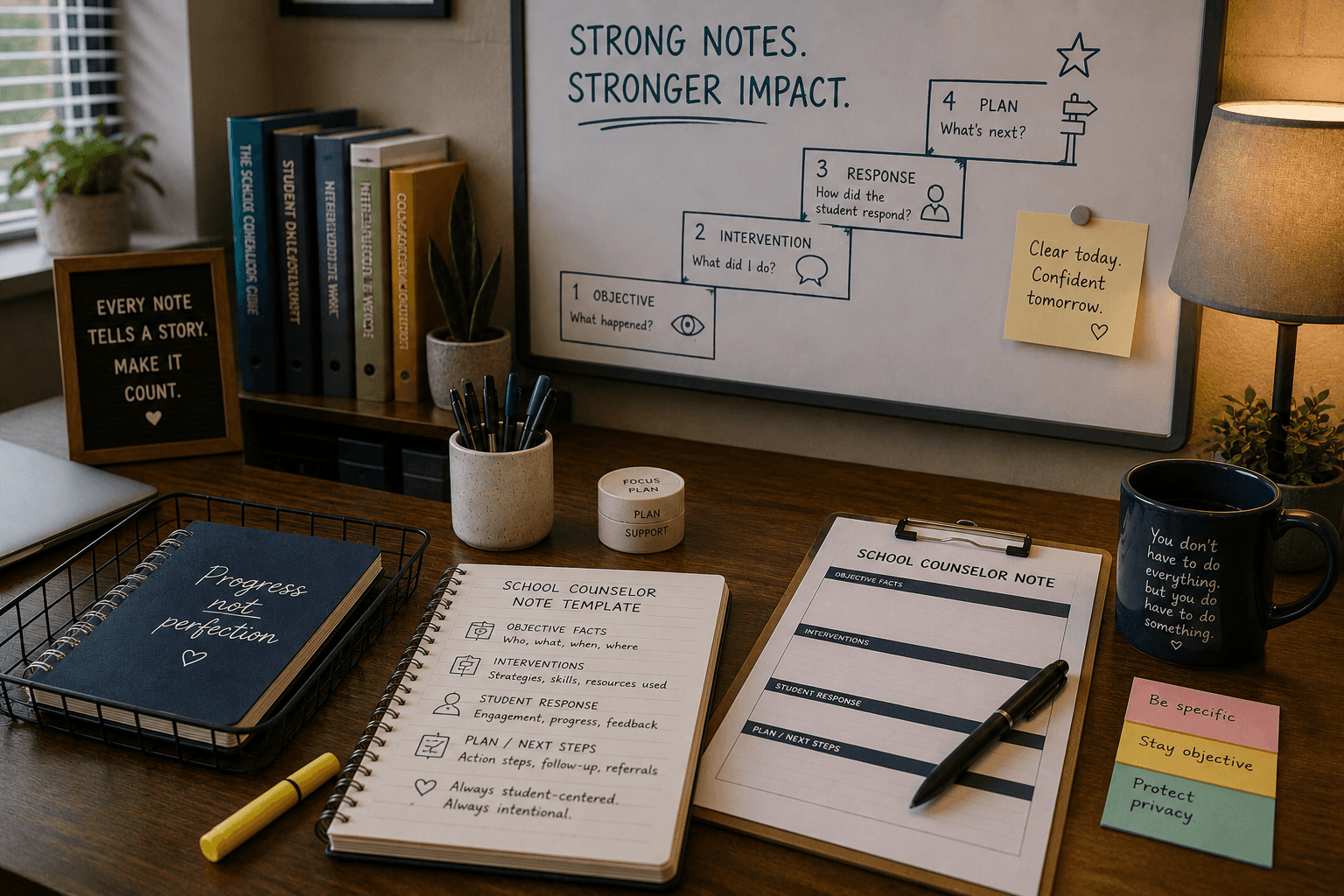
A printable DAP progress note template designed specifically for school counselors is available from various online platforms.
BIRP Notes
BIRP stands for Behavior, Intervention, Response, Plan. This format emphasizes the therapeutic process and how the student responds to specific interventions.
Component | School Counseling Example |
|---|---|
B – Behavior | “Student reported increased irritability and difficulty concentrating. He disclosed that he has been sleeping only four hours per night due to racing thoughts.” |
I – Intervention | “Counselor introduced the ‘5‑4‑3‑2‑1’ grounding technique. Counselor modeled the technique, then student practiced it with coaching.” |
R – Response | “Student reported feeling ‘a little calmer’ after the grounding exercise. He rated his anxiety as 6/10 before the exercise and 4/10 after.” |
P – Plan | “Student will practice the grounding technique daily and log his anxiety levels before and after. Follow‑up in one week.” |
GIRP Notes
GIRP stands for Goals, Intervention, Response, Plan. This format is ideal for solution‑focused or goal‑oriented counseling.
Component | School Counseling Example |
|---|---|
G – Goals | “Student’s goal is to reduce test anxiety so that she can complete exams without physical symptoms of panic.” |
I – Intervention | “Counselor guided student through a progressive muscle relaxation exercise. Student also practiced positive self‑talk statements (‘I have prepared for this test’).” |
R – Response | “Student reported that the relaxation exercise reduced her heart rate and muscle tension. She stated, ‘I think I could do this before a test.’” |
P – Plan | “Student will practice relaxation for five minutes before each exam this week. Follow‑up in three days to review effectiveness.” |
Additional Formats
FIRP (Feelings, Intervention, Response, Plan): Particularly useful for emotion‑focused or trauma‑focused work.
The NovoNote Template: A comprehensive digital template designed specifically for school‑based mental health professionals. It includes structured sections for current presentation, background, mental status exam, session content, interventions, progress and challenges, risk assessment, collaboration, and next steps. NovoNote also offers a free note template generator.
Part 3: Aligning with Professional Standards — ASCA, FERPA, and HIPAA
Documentation does not exist in a vacuum. Your notes must comply with professional standards, federal privacy laws, and ethical guidelines.
The ASCA National Model (Fifth Edition)
The 2025 ASCA National Model (5th Edition) preserves the foundational framework while integrating updates that reflect current student needs and counseling best practices. The core components are now reframed as Define, Manage, Deliver, and Assess. Key updates include:
Greater emphasis on equity and access: School counselors are guided to assess barriers within school structures, policies, and practices, using disaggregated data to highlight opportunity gaps and advocate for historically marginalized student populations.
Integration of mental health into program delivery: Mental health and wellness are more deeply embedded within the delivery and assessment components, with greater guidance on collaborating with school‑based mental health professionals as part of a comprehensive support system.
Refined use of data and documentation: New templates for action plans, results reports, and time‑on‑task documentation provide streamlined tools that enhance clarity and alignment with building and district goals. Updated data categories now include access, life‑readiness, and academic success.
The ASCA National Model® templates are available for download on the official website. A video training on the fifth edition templates was aired on August 11, 2025.
FERPA (Family Educational Rights and Privacy Act)
FERPA is the primary federal law governing student education records, including school counseling notes. Key points for school counselors:
FERPA applies to all educational records maintained by an educational agency or institution, including counseling notes that are kept in the student’s educational record.
Parents have the right to inspect and review their child’s education records (unless the student is 18 or attends a postsecondary institution).
Schools must have written permission from the parent or eligible student to disclose personally identifiable information from education records, except under specific exceptions (e.g., to school officials with legitimate educational interest, in health or safety emergencies).
“Sole possession” records (notes kept in the sole possession of the maker, used only as a personal memory aid, and not accessible or revealed to any other person) are not considered education records under FERPA. However, if you share these notes with anyone (another counselor, administrator, teacher), they immediately become education records subject to FERPA.
HIPAA (Health Insurance Portability and Accountability Act) and the FERPA/HIPAA Distinction
Many school‑based counselors are confused about whether HIPAA applies to their work. The key is context:
FERPA generally applies to records maintained by educational institutions.
HIPAA generally applies to records maintained by healthcare providers.
If you are employed by a school district and your counseling notes are kept as part of the student’s educational record, FERPA (not HIPAA) governs their confidentiality. However, if you are a contract mental health provider operating a separate practice within the school, HIPAA may apply.
The U.S. Department of Education and the U.S. Department of Health and Human Services have issued joint guidance stating that FERPA takes precedence for most school‑based counseling records.
Practical advice for school counselors:
Know your employment status and who “owns” your notes.
Never share “sole possession” notes with anyone unless you are prepared for them to become part of the official educational record.
When in doubt, consult your school district’s legal counsel or records officer.
Best Practices for School Counseling Documentation
The following strategies, derived from both the literature and experienced practitioners, will elevate your documentation from adequate to excellent.
1. Use a Standardized Template
A standardized template ensures that no essential element is missed. Whether you use SOAP, DAP, BIRP, GIRP, or a custom format, stick to it consistently.
2. Write Promptly
Complete your notes as soon as possible after the session. Memory fades rapidly, and delayed documentation is less accurate and less defensible.
3. Be Specific, Not Vague
Avoid phrases like “student seemed upset” or “counselor provided support.” Instead, write “student’s eyes were red and teary; she stated, ‘I’ve been crying every day’” and “counselor taught student three deep‑breathing techniques (box breathing, 4‑7‑8 breathing, belly breathing); student practiced each with guidance.”
4. Distinguish Observation from Interpretation
When you write “student was anxious,” you are interpreting. When you write “student’s hands were shaking; she spoke rapidly and jumped at the sound of a door closing,” you are observing. Both have value, but be clear about which is which.
5. Document What You Did (Interventions)
Payers and reviewers want to know what you actually did. “Counselor used cognitive restructuring to challenge the student’s belief that ‘everyone is laughing at me’” is better than “counselor talked with student.”
6. Record the Student’s Response
The student’s response to your intervention is critical data for evaluating effectiveness. “Student reported that the grounding technique reduced her anxiety from 8/10 to 5/10” is far more useful than “student seemed to benefit.”
7. Document Collaboration
If you spoke with a teacher, parent, or outside provider, record the date, mode of communication, and a summary of what was discussed. This creates a complete picture of the student’s support system.
8. Review for Compliance
Before finalizing your note, run through a mental checklist:
Have I included all relevant student information?
Is the date and time of the session recorded?
Did I clearly outline the session’s goals?
Are my notes specific and detailed?
Have I reviewed my notes for compliance with FERPA?
Is the documentation stored securely?
9. Avoid Common Pitfalls
Common mistakes include inadequate detail, vague language, and neglecting compliance. Also avoid:
Writing notes that are identical from session to session (copy‑and‑paste errors).
Including extraneous personal information about the student or family that is not relevant to the counseling goals.
Failing to document risk assessment when risk is present.
10. Secure Storage
Ensure that all documentation is stored in a secure, compliant manner. If your notes are part of the student’s educational record, they must be stored according to district policies. If they are kept separately as “sole possession” notes, they must be kept in a locked file or password‑protected digital folder accessible only to you.
Sample Templates for Immediate Use
Below are three practical templates you can adapt for your own practice. Each is based on the formats described above.
Sample 1: Quick DAP Note for School Counselors
Sample 2: Comprehensive School Counseling SOAP Note
Sample 3: BIRP Note for Intervention‑Focused Sessions
FAQ
What are the essential components of a school counseling note?
A complete school counseling note should include: student information, date and time, session goals, a detailed narrative of the session (including student presentation, key themes, interventions used, and student response), assessment of progress, a plan for follow‑up, and any collaboration with parents, teachers, or other professionals.
Are school counseling notes protected by HIPAA?
It depends. If you are employed by a school district and your notes are maintained as part of the student’s educational record, they are governed by FERPA, not HIPAA. If you are a contract mental health provider operating a separate practice within the school, HIPAA may apply. The key distinction is whether the record is considered an “education record” under FERPA.
What is the difference between SOAP, DAP, and BIRP notes?
SOAP (Subjective, Objective, Assessment, Plan) separates the student’s report from the counselor’s observations. DAP (Data, Assessment, Plan) simplifies this by combining subjective and objective into a single “Data” section. BIRP (Behavior, Intervention, Response, Plan) emphasizes the therapeutic process and how the student responds to specific interventions.
How does the 2025 ASCA National Model affect documentation?
The 2025 ASCA National Model (5th Edition) introduces updated templates for action plans, results reports, and time‑on‑task documentation. It also places greater emphasis on equity, mental health integration, and meaningful data use. School counselors are encouraged to use disaggregated data to highlight opportunity gaps and advocate for marginalized student populations.
Where can I find free or low‑cost school counseling note templates?
Free templates are available from several sources: AutoNotes offers a free school counseling note template with an example, Jotform has a customizable School Counseling Progress Note template, and NovoNote provides a free note template generator. For printable PDFs, TES.com offers a DAP progress note template for school counselors and a comprehensive counseling session form.
Conclusion
Documentation may never be the most glamorous part of your work as a school counselor. But it is among the most essential. A well‑crafted note tracks a student’s journey, communicates your professional judgment, justifies your interventions, and — in the worst of circumstances — protects your license and your school from liability.
By adopting a structured template, aligning your documentation with ASCA standards, mastering the FERPA/HIPAA distinctions, and avoiding common pitfalls, you can transform note‑taking from a burden into a strategic asset. The time you invest in learning to write excellent notes is time invested in your own professional sustainability — and, more importantly, in the students who depend on you to keep their stories safe and their progress on track.
References
AutoNotes. (2026). School Counseling Note Template (Free Example + Download).
Notenest. (2024). Top 20 Best Counseling Notes Template with Examples.NovoPsyZch. (2025). NovoNote Template: Schools – Therapy Session.
YMC Legal. (2025). Legal Guidelines and Best Practices for School Based Counseling Programs.
Jotform. (2026). School Counseling Progress Note Form Template.
https://support.jotform.com/form-templates/school-counseling-progress-note
Keep Indiana Learning. (2025). Transforming Schools through Implementing the 2025 ASCA Model.
ASCA. (2025). ASCA National Model®, Fifth Edition Templates.
TES. (2025). Printable DAP Progress Note Template for School Counselors.
ERIC. (n.d.). Professional Counselor‘s Guide to Federal Law on Student Records.
If you’re ready to spend less time on documentation and more on therapy, get started with a free trial today
Not medical advice. For informational use only.
Outline
More articles