
May 7, 2026
The distress tolerance module is often introduced as the “crisis survival” part of DBT — the skills a client uses when the emotional wave is too high to think, let alone problem-solve. But that framing, while accurate, misses the deeper clinical reality. Distress tolerance isn’t just about getting through the next ten minutes without self‑harming. It‘s about fundamentally shifting a client’s relationship with emotional pain from one of panic‑driven avoidance to one of mindful survival.
For the clinician, teaching these skills effectively requires more than walking through a handout. It demands a nuanced understanding of which skill fits which crisis, when to push for acceptance versus when to reach for distraction, and how to sequence the module so that clients don’t confuse “tolerating pain” with “giving up on change.”
Crisis Survival vs. Reality Acceptance: The Sequencing Error That Derails Treatment
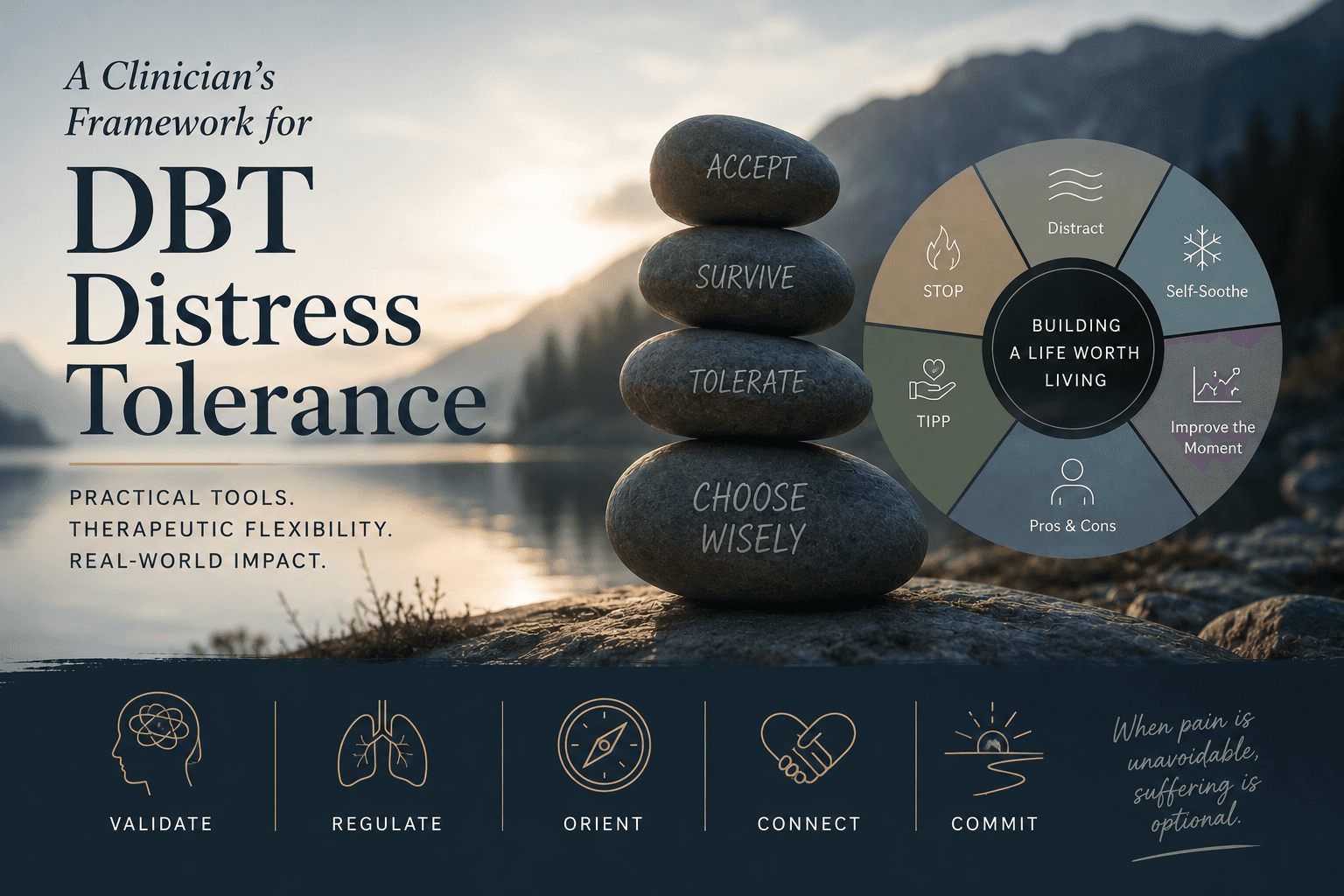
DBT‘s distress tolerance module is built on a categorical distinction that many clinicians — and nearly all clients — initially miss. Crisis survival skills (TIPP, ACCEPTS, IMPROVE, self‑soothe, pros and cons) are for acute emergencies. Reality acceptance skills (radical acceptance, turning the mind, willingness vs. willfulness) are for the longer‑term work of making peace with circumstances that cannot be immediately changed.
The mistake that consistently generates dropout and resistance is teaching radical acceptance before clients have any crisis survival skills in their pocket. Trying to help a client accept reality while they are still actively flooded is like teaching meditation to someone having a panic attack — it doesn‘t work, and it makes the client feel like a failure.
The clinical rule is straightforward: start with TIPP and ACCEPTS. Only after clients have had several weeks of practising fast‑acting biological and distraction‑based strategies should reality acceptance work be introduced. Sequence matters as much as content.
TIPP: The Biological Override
TIPP stands for Temperature, Intense exercise, Paced breathing, and Paired muscle relaxation. It is the most physiologically direct of the distress tolerance skills, and it is typically the first skill taught in the module because it works regardless of whether the client “believes” in it.
Temperature: The client submerges their face in cold water (or applies an ice pack to the eyes) while holding their breath for 15–30 seconds. This triggers the mammalian dive reflex — a vestigial survival response that slows heart rate, constricts peripheral blood vessels, and shifts blood flow to vital organs. The effect is a near‑immediate reduction in physiological arousal. In research settings, cold water facial immersion has been used to treat paroxysmal supraventricular tachycardia (PSVT), a medical condition involving episodes of very rapid heart rate. The dive reflex is an innate, multi‑system physiologic response that preserves oxygen stores during water immersion. It is one of the few psychological interventions that directly and reliably down‑regulates the sympathetic nervous system in seconds.
Clinical caution: The temperature skill is contraindicated for clients with certain medical conditions, including cardiac arrhythmias, a history of seizures, or severe autonomic dysregulation. Clients taking beta‑blockers or other heart medications should consult their physician before using this technique.
Intense exercise: For emotional intensity in the 6–8 range (rather than a full 9–10 crisis), 10–20 minutes of vigorous aerobic activity can metabolise stress hormones and reduce hyperarousal. The mechanism is straightforward: the body cannot sustain both high‑intensity exercise and high‑intensity anxiety simultaneously. By the time the client has done 50 jumping jacks or run up and down a flight of stairs, the physiological state has shifted enough to make other coping strategies accessible.
Paced breathing and paired muscle relaxation: These are the parasympathetic anchors of TIPP. The key instruction is to make the exhale longer than the inhale. The vagus nerve, a major pathway of the parasympathetic nervous system, is activated during slow, controlled exhalation, reducing heart rate and blood pressure. Paired muscle relaxation (tensing and then releasing muscle groups sequentially) provides additional somatic feedback that the threat has passed.
The power of TIPP lies in its bypass of the cognitive system. A client who cannot string together a coherent sentence during a panic attack can still splash cold water on their face. That is why TIPP comes first in the module: it works when thinking doesn‘t.
ACCEPTS and IMPROVE: Distraction as a Legitimate Clinical Tool
Distraction is often seen as avoidance in other therapeutic models. In DBT, distraction is reframed as strategic disengagement — a temporary shift in attention that lowers emotional intensity just enough to prevent destructive action.
Wise Mind ACCEPTS is an acronym for nine distraction categories:
Activities: Engage in something that requires attention (clean, organise, watch a film).
Contributing: Do something for someone else (volunteer, write a note of appreciation).
Comparisons: Compare your situation to something worse or to your own past struggles.
Emotions: Generate a different emotion (watch a comedy, listen to angry music).
Pushing away: Temporarily block the distressing situation from awareness (visualise a wall, mentally put the problem in a box).
Thoughts: Replace distressing thoughts with neutral or pleasant ones (count, recite song lyrics, do a puzzle).
Sensations: Create an intense but safe physical sensation (hold an ice cube, eat a sour candy, take a hot shower).
IMPROVE the Moment offers a parallel set of strategies:
Imagery: Mentally escape to a safe or pleasant place.
Meaning: Find something meaningful or purposeful in the pain.
Prayer: For clients with spiritual or religious frameworks, prayer can provide comfort.
Relaxation: Progressive muscle relaxation, deep breathing, or yoga.
One thing in the moment: Focus entirely on a single neutral activity (washing one dish, walking one step).
Vacation: Take a brief mental break — a few minutes of imagining a beach or a forest.
Encouragement: Use self‑talk that is kind and realistic rather than harsh or catastrophic.
The clinical nuance that many therapists miss is that ACCEPTS and IMPROVE are not interchangeable. ACCEPTS is for active distraction — the client needs to shift their attention away from the source of distress. IMPROVE is for reframing — the client stays with the distress but changes its meaning or their relationship to it. Knowing which a client needs in a given moment is a matter of clinical judgment and trial.
The trap: Distraction skills are potent, and clients who have suffered for years will often cling to them, using distraction to avoid any real problem‑solving. The phrase “crisis survival” is the limiting principle: these skills are for crises — high‑stress, short‑term situations where immediate action would make things worse. They are not a substitute for emotion regulation, nor are they a way to avoid building a life worth living. Excessive use of distraction leads to problems piling up, and the eventual goal is for clients to see that accepting reality and tolerating distress lead to better outcomes than rejecting reality and refusing to tolerate distress.
The goal is not to eliminate pain but to survive it long enough to do something effective.
Pros and Cons: When the Urge Is Strong
Pros and cons is the most cognitively demanding of the crisis survival skills, and it is therefore least useful at the peak of emotional intensity. It is best introduced once the client has already used TIPP or ACCEPTS to lower their arousal from a 9 to a 6.
The exercise is simple: list the pros and cons of acting on the crisis urge (self‑harm, substance use, aggression, withdrawal), and list the pros and cons of resisting the urge and using a skill. The goal is not to discover new information but to make the decision explicitly, deliberately, and with awareness.
In practice, most clients already know the cons of acting on urges. What they lack is the capacity to access that knowledge when overwhelmed. The written pros and cons list becomes a cognitive anchor — something they can look at when thinking is hard. It is therefore essential that clients create their own personalised pros and cons cards to carry with them, not just complete the exercise once in session and never revisit it.
STOP: The Pause Before the Fall
The STOP skill is deceptively simple, and for that reason it is often under‑taught. It is the first skill in the crisis survival sequence, not because it is the most powerful, but because it is the most accessible:
Stop: Freeze. Do not move a muscle. Do not react.
Take a step back: Breathe. Create a sliver of space between the urge and the action.
Observe: Notice what is happening inside and outside. What is the situation? What are the thoughts and feelings? What are the urges?
Proceed mindfully: Choose an action based on the situation and your goals, not on raw impulse.
STOP is the skill that interrupts the automatic chain from trigger to urge to destructive action. It does not solve the crisis, but it creates the possibility of choosing a different response.
The key instruction that is often omitted: do not move a muscle. The body‘s urge to act is powerful; physically freezing interrupts the momentum and gives the cognitive system a fighting chance.
Radical Acceptance and the “Turning the Mind” Practice
Once clients have acquired a reliable set of crisis survival skills, reality acceptance work can begin. Radical acceptance is the full, complete acknowledgment of reality as it is, without resistance, judgment, or denial. It is not approval, forgiveness, or passivity. It is the cessation of fighting with what has already happened.
The clinical paradox is that radical acceptance is both essential and impossible to force. Clients cannot be argued into acceptance. They can only be supported in practising acceptance repeatedly, knowing that the mind will rebel, and then practising it again — what Linehan called “turning the mind.”
The practical sequence:
Distinguish pain from suffering. Pain is the unavoidable distress caused by the event itself. Suffering is the added layer of resistance, denial, and “this shouldn‘t have happened.” Pain is inevitable; suffering is optional.
Name the reality that is being rejected. Clients must articulate what they are fighting against. “I am fighting the fact that my father abandoned me.” “I am fighting the fact that I have this illness.”
Practice acceptance in small doses. Acceptance is not a one‑time decision; it is a repeated practice. The client commits to accepting the painful reality for a few minutes, then a few hours, then a day.
Use “turning the mind” when acceptance slips. The mind will naturally drift back into rejection. Turning the mind is simply noticing the drift and deliberately choosing acceptance again.
Radical acceptance can be taught too early, and that error is damaging. But it is also possible to postpone acceptance indefinitely, keeping clients in a cycle of endless crisis survival without ever helping them grieve and move forward. The art of the distress tolerance module is knowing when each client is ready for which skill.

Contraindications and Medical Precautions
Distress tolerance skills are generally safe, but not universally so. The TIPP temperature skill, in particular, requires medical screening for certain populations.
The dive reflex involves significant cardiovascular changes, including bradycardia and increased peripheral vascular resistance. For individuals with a history of heart conditions, arrhythmias, or uncontrolled hypertension, cold water immersion should be approached with caution, if at all. Clients taking beta‑blockers or other medications that affect heart rate are also at higher risk.
The intense exercise component is contraindicated for clients with eating disorders who may use exercise punitively, as well as for those with certain musculoskeletal or cardiovascular conditions. For these clients, the paced breathing and paired muscle relaxation components can be substituted.
More broadly, distress tolerance skills are not for everyday problems or for solving all of life’s difficulties. Overuse of crisis survival skills can become a form of avoidance, and clients who rely exclusively on distraction without ever engaging in problem‑solving will find that their difficulties accumulate rather than resolve.
The NICE guideline (NG62) recommends DBT as a treatment option for Borderline Personality Disorder, a population for whom distress tolerance deficits are often central. That recommendation, however, assumes that DBT is delivered with fidelity — including the careful sequencing, contraindication screening, and ongoing monitoring that distinguish skilled DBT from a handout and a hope.
Documentation: Tracking Distress Tolerance in the Record
For clinicians supervising DBT programmes or billing for DBT‑informed treatment, documentation must reflect the specific skills taught, the client‘s response, and the degree of generalisation to daily life.
A useful framework for progress notes:
Skill taught and practiced: Which specific crisis survival or reality acceptance skill was the focus of the session (e.g., “TIPP temperature skill” rather than “distress tolerance”)?
Context of use: What situation triggered the use of the skill? Was it used preventively or reactively?
Degree of success: On a 0–10 scale, how effective was the skill in reducing the urge to act destructively? Did the client require coaching to complete the skill?
Homework assigned: Which skill will the client practise between sessions? What specific crisis situations are they likely to face?
Generalisation check: Did the client use any distress tolerance skills outside of session since the last appointment? If not, what got in the way?
A well‑documented distress tolerance session provides a clear picture of treatment trajectory and justifies medical necessity in a way that generic “worked on coping skills” entries cannot.
Integrating Distress Tolerance into Broader Treatment
Distress tolerance is not a standalone intervention. It sits within a four‑module structure alongside mindfulness, emotion regulation, and interpersonal effectiveness. The relationship between modules is sequential and causal: mindfulness practice makes distress tolerance possible; distress tolerance creates the stability needed for emotion regulation; and only when emotions are manageable can interpersonal effectiveness be meaningfully practised.
For clients with substance use disorders, eating disorders, or borderline personality disorder, low distress tolerance is a transdiagnostic vulnerability factor. A meta‑analysis of 81 studies found significant negative correlations between distress tolerance and problematic substance use, disordered eating behaviours, and BPD symptomatology, with the magnitude of these associations consistent across disorders. This supports the transdiagnostic role of distress tolerance — deficits in DT predict impulsive‑type psychopathology regardless of diagnostic category. Teaching distress tolerance skills, therefore, is not merely a crisis intervention; it is a core mechanism of change across multiple conditions.
At the same time, clinicians should be cautious about over‑prescribing distress tolerance skills to the exclusion of other modules. Clients who cope by constantly distracting but never problem‑solving may be using crisis survival skills as a form of avoidance, and the eventual therapeutic goal is for clients to see that accepting reality and tolerating distress lead to better outcomes than rejecting reality and refusing to tolerate distress.
The most common error in DBT delivery is staying in the distress tolerance module too long. The module is meant to stabilise; it is not meant to be a permanent home.
When Distress Tolerance Fails
Even with skilful teaching, some clients will struggle to use distress tolerance skills effectively. Common barriers include:
Using skills only at a 10/10 intensity. By the time a client reaches peak distress, it may be too late to initiate a complex skill. The solution is to lower the threshold for skill use — practising at a 5 or 6 so that the skill is automatic when intensity rises.
Rejecting skills as “stupid” or “childish.” For clients who pride themselves on intellect or independence, distraction techniques can feel infantilising. Normalising this resistance is essential: “It‘s completely normal to feel like this is silly. The question is not whether it feels silly. The question is whether it works.”
Inconsistent practice between sessions. Distress tolerance skills, like any skill, require repetition. Clients who only practise in session will not have the skill available in a real crisis. Diary cards, between‑session coaching, and structured homework assignments are the main tools for increasing generalisation.
Unaddressed trauma. For clients with significant trauma histories, certain distress tolerance skills (particularly the STOP skill or certain self‑soothing activities) may inadvertently trigger dissociative responses. In such cases, the DBT trauma protocol or a phased approach that stabilises before activating exposure is required.
When a client repeatedly fails to use skills despite adequate teaching, the problem is rarely “resistance.” It is usually a mismatch between the skill and the client‘s current capacity, a lack of sufficient in‑session practice, or the presence of an untreated comorbid condition.
Key Takeaways
Sequence matters. Crisis survival skills (TIPP, ACCEPTS, IMPROVE) must be taught before reality acceptance skills (radical acceptance, turning the mind). Teaching radical acceptance to a client in acute crisis is a sequencing error that generates dropout and resistance.
TIPP is the biological anchor. Cold water facial immersion triggers the mammalian dive reflex, directly reducing physiological arousal. Contraindications include cardiac conditions, seizure history, and beta‑blocker use.
Distraction is strategic, not avoidant. ACCEPTS and IMPROVE are legitimate crisis survival tools, but they become maladaptive when overused to avoid problem‑solving. The limiting principle is “crisis.”
Pros and cons and STOP are cognitive anchors. These skills are least useful at peak distress and most useful once arousal has been reduced to a 6 or 7. Personalised, portable pros and cons cards are essential.
Distress tolerance deficits are transdiagnostic. Meta‑analytic evidence supports the role of low DT across substance use, eating disorders, and BPD, making DBT distress tolerance skills relevant beyond their original population.
Documentation must be specific. Generic “worked on coping skills” notes do not justify medical necessity. Session records should name the skill taught, the context of use, the client‘s response, and evidence of generalisation to daily life.
FAQ
What is the most common clinical mistake when teaching DBT distress tolerance skills?
Teaching radical acceptance before clients have acquired crisis survival skills. Reality acceptance work requires some capacity to tolerate distress; introducing it too early generates frustration, increases dropout rates, and may inadvertently reinforce the client’s belief that “DBT doesn’t work for me.”
Are distress tolerance skills appropriate for clients with eating disorders?
Yes, with modifications. The intense exercise component of TIPP may be contraindicated for clients who use exercise punitively. For these clients, paced breathing, paired muscle relaxation, and the temperature skill are safer alternatives. The ACCEPTS and IMPROVE skill sets are generally well tolerated, though clinicians should monitor for any use of distraction to avoid meal‑related distress.
How does distress tolerance differ from emotion regulation?
Distress tolerance skills are for acute crisis survival — getting through the next ten minutes without making things worse. Emotion regulation skills are for managing the intensity and duration of emotions over hours and days. Distress tolerance must come first; a client who cannot survive a crisis cannot begin to regulate the underlying emotion.
What medical conditions contraindicate the TIPP temperature skill?
The dive reflex induced by cold water facial immersion causes bradycardia and peripheral vasoconstriction. Clients with a history of cardiac arrhythmias, pacemakers, uncontrolled hypertension, seizure disorders, or a known sensitivity to cold should avoid this skill or consult their physician before use. Clients taking beta‑blockers or other medications affecting heart rate are also at higher risk.
Can distress tolerance skills be taught in individual therapy, or must they be taught in a group?
Skills can be taught in either format, but the research base for DBT skills training is primarily group‑based. Groups provide opportunities for observational learning, peer reinforcement, and normalisation of difficulties that individual therapy cannot easily replicate. Many clinicians teach distress tolerance skills in individual sessions while also referring clients to a DBT skills group for the full four‑module curriculum.
References
Pabau. (2026). Dbt Distress Tolerance Skills: A Clinical Reference for Practitioners.
Linehan, M. M. (2015). DBT Skills Training Handouts and Worksheets, Second Edition. Guilford Press.
Pacific Coast Therapy. (2023). TIPP Skills Part 1: Temperature and Intense Exercise.
National Center for Biotechnology Information. (2026). Physiology, Diving Reflex. StatPearls.
PsychVitals. (2020). Distress Tolerance Crisis Survival Skills Handouts.
Deconstructing Stigma. (2026). DBT Distress Tolerance Explained: Skills and Strategies.
If you’re ready to spend less time on documentation and more on therapy, get started with a free trial today
Not medical advice. For informational use only.
Outline
More articles