Beyond the Basics: A Clinician's Guide to IFS Training, Certification and Clinical Integration

May 4, 2026
Internal Family Systems (IFS) therapy has moved beyond its niche origins to become one of the most widely adopted and respected models in contemporary psychotherapy. Yet for the practicing clinician, navigating the training landscape, understanding what each level actually teaches, and making strategic decisions about certification can feel opaque. This guide cuts through the promotional language to examine the IFS training pathway from a clinical perspective, focusing on what you will actually learn, how the credentialing process works, and how IFS integrates with other evidence-based modalities.
The Training Architecture – What Each Level Actually Teaches
The IFS Institute structures its training around three progressive levels. Each level serves a distinct clinical purpose, and understanding the differences is essential for planning your professional development.
Level 1: Foundational Competence
The Level 1 training is designed to develop both conceptual understanding and practical clinical skills. Programs typically run 80-100 hours, delivered through a mix of lecture, discussion, live demonstration, video review, experiential exercises, and small-group practice with close guidance from experienced Program Assistants. A Certificate of Completion requires attending at least 75 of approximately 89.5 program hours.
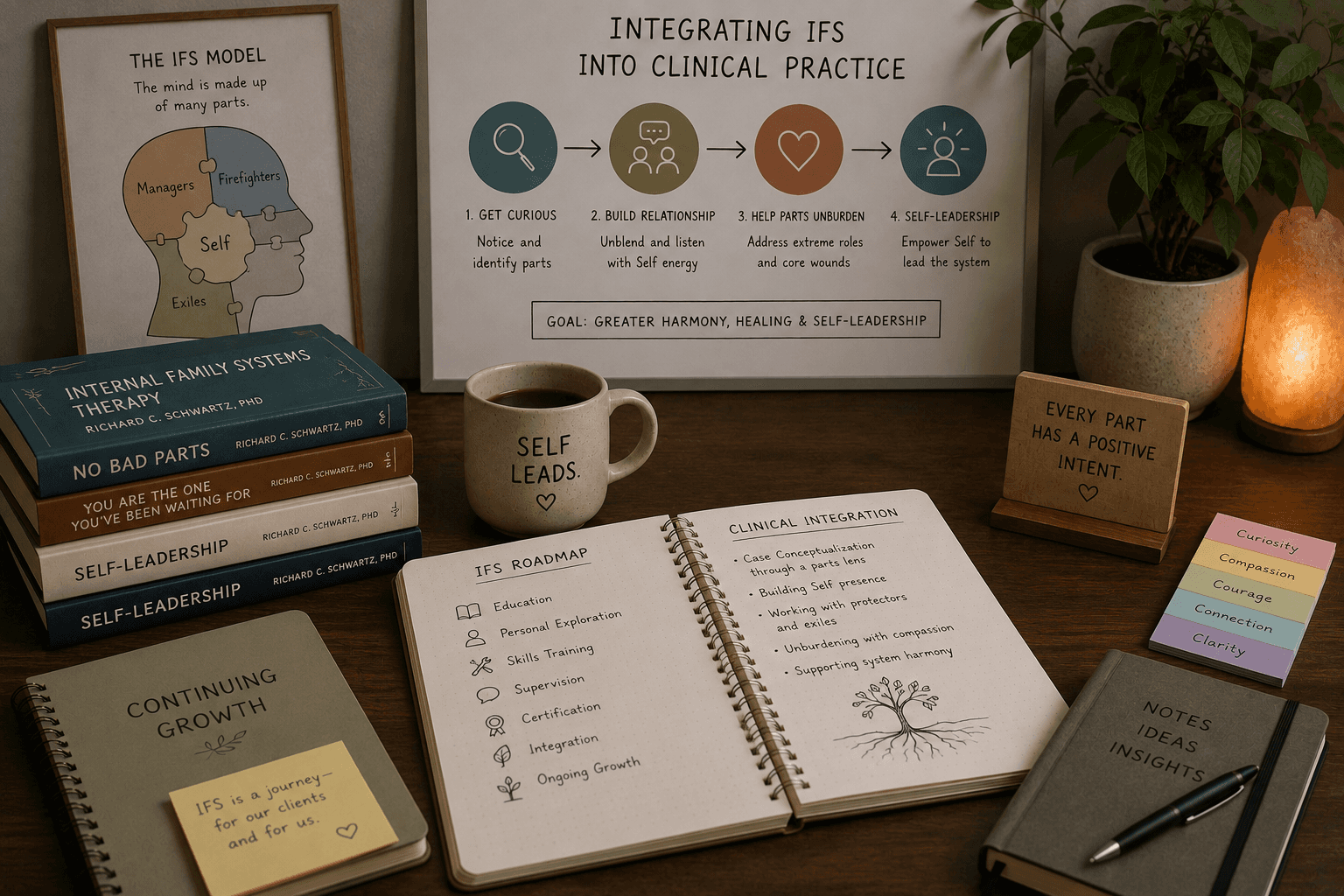
The clinical curriculum moves through a logical progression. Early sessions introduce the core assumptions of the model: the non-pathological view of the mind's multiplicity, the concept of "Self" as the natural leader of the internal system, and the three primary roles of parts (managers, firefighters, exiles). As the training deepens, participants learn to differentiate parts from Self, understand the sequential and relational patterns between parts, and practice the "unblending" process that allows therapists and clients to speak for parts rather than from them.
A key clinical skill taught in Level 1 is the Six Fs protocol (Find, Focus, Flesh out, Feel toward, Fears, Befriend). This structured sequence provides a reliable method for approaching any protective part in a way that builds trust rather than triggering defensive reactions. The training also covers the flow of the model — how to move from identifying a target part through unblending and witnessing to, when appropriate, unburdening the wounded parts beneath.
Importantly, Level 1 is not purely didactic. Participants are invited to explore their own inner systems within the safe container of the training, recognizing that personal access to Self-energy is foundational to effective IFS therapy. The training includes multiple opportunities for supervised application of IFS interventions, with a required focus on healing wounded parts.
Level 2: Deepening and Specialization
Level 2 training builds directly on Level 1 experience, requiring a Certificate of Completion from an IFS Level 1 program for eligibility. Unlike the broad foundation of Level 1, Level 2 trainings are structured around specific clinical applications. A Level 2 training requires completion of 27 out of 32 program hours for the Certificate of Completion.
Available specializations include:
IFS for Addictions and Eating Disorders (Level 2, 1362): This training applies the IFS lens to addictive processes, including substance use and eating disorders, focusing on understanding "firefighter" parts — the extreme protectors that emerge when exiled pain threatens to surface. Participants learn techniques for unblending, collaboration and negotiation, and direct access with extreme firefighters, along with steps for healing the shame, fear, trauma, and legacy burdens underneath.
IFS for Couples (Intimacy from the Inside Out - IFIO): This adaptation applies IFS principles to intimate partnerships, exploring how the internal parts of each partner interact within the relational system. The focus is on helping couples move from polarized positions to collaborative Self-led connection.
IFS for Trauma and Complex Presentations: Some Level 2 programs concentrate on treating clients with extremely protective systems or histories of childhood trauma, focusing on working with internal polarizations, dangerous firefighters, and the unburdening process. These trainings emphasize the importance of the therapeutic relationship by deepening awareness of both the client's and therapist's parts.
IFS Level 2 Intensive (General): Some programs offer a general deepening format that covers advanced IFS processes without a specific population focus, maintaining the same balance of didactic and experiential learning found in Level 1 but at a higher level of complexity.
The Level 2 curriculum explicitly prepares participants for clinical challenges that go beyond the straightforward presentations typically used in Level 1 demonstrations.
Level 3: Mastery and Leadership
Level 3 training represents the highest level of IFS education offered by the Institute. Eligibility requires a Level 2 Certificate of Completion, and the Institute recommends waiting at least six months after completing Level 2 before beginning Level 3 to allow for integration and practice.
Level 3 trainings are intensive, typically four to five days in duration, with tuition ranging from approximately $2,700 to $3,200. They are designed for experienced IFS practitioners who want to deepen their mastery of the model and, for some, pursue leadership roles within the IFS community, including the path toward becoming an Approved Clinical Consultant or Trainer.
At this level, the focus shifts from learning techniques to refining clinical intuition, working with the most challenging presentations, and developing the capacity to teach or supervise others in the model. Level 3 participants engage in advanced case consultation, receive intensive feedback on their clinical work, and explore the subtleties of Self-led practice at a depth not possible in earlier levels.
IFS Certification – Separating Credential from Competence
A persistent point of confusion in the IFS community is the distinction between completing a Level 1 training and becoming IFS Certified.
A Certificate of Completion simply verifies that you have attended the required number of training hours. It signals exposure to the material, not competence in applying it. As the IFS Institute itself states, "IFS Certification is not an entry level process. Individuals should have relevant field experience prior to beginning the process."
IFS Certification is a separate, post-training process that requires:
A master's degree or higher in a human services field (for the Therapist track) or appropriate registration/certification in the applicant's own field (for the Practitioner track)
Active licensure, registration, or certification for clinical practice in the applicant's country of residence
Completion of a Level 1 IFS Training
A formal application with a $200 fee ($50 application, $150 for application review)
Submission of a video-recorded session (up to 60 minutes) for review, at a cost of $200 (additional time prorated at $150)
Recertification every two years at a cost of $150, requiring documentation of 20 IFS Continuing Education Credit hours
Benefits of IFS Certification include the right to use the "IFS Certified" title in professional advertising and, significantly, priority listing on the IFS Institute Directory — a direct channel for client referrals. Certified therapists are also eligible to pursue the Approved Clinical Consultant (ACC) designation and, eventually, the Trainer Track.
For those considering certification, a pragmatic question: is the return on investment worth the time and fees? For clinicians building a referral-based practice, directory placement and formal credentialing can accelerate growth. For those whose practices are already full, the value may be more personal — a meaningful marker of advanced competence and professional commitment. The Institute recommends starting the certification process after sufficient clinical experience with the model, not immediately upon completing Level 1.
The Approved Clinical Consultant (ACC) Pathway
For certified IFS therapists who wish to supervise others, the ACC designation represents the next tier of professional recognition. ACCs play a vital role in the IFS community by supporting Certification Candidates through skill-building and evaluation.
Prerequisites for applying for ACC designation include active IFS Certification, active licensure with supervisory experience, at least three years since completing Level 1 training, clinical consultation experience, and a recommendation rubric from an IFS Lead Trainer. The ACC designation must be renewed every two years, aligned with IFS Certification renewal.
The Financial Investment – Tuition, Payment, and Scholarships
Understanding the financial commitment is essential for planning. IFS Institute does not offer payment plans; tuition is generally paid as a one-time payment or through a deposit-plus-balance structure.
Tuition Estimates (2026):
Program | Format | Tuition (USD) |
|---|---|---|
Level 1 Online | Live, real-time | $3,200 – $3,990 |
Level 1 Hybrid | Online + in-person sessions | $4,950 |
Level 2 Online | Live, real-time | $2,550 – $3,200 |
Level 3 Online | Live, real-time | $2,700 – $3,200 |
Note: These figures are subject to change based on specific training dates and locations.
Scholarships
The IFS Institute offers several categories of need-based and identity-based scholarships to increase accessibility:
Economic need scholarship: For applicants with demonstrated financial need
Full-time student scholarship: Tuition reduction for full-time graduate and undergraduate students
Racial/LGBTQ scholarship: For individuals who are racially underrepresented or in the LGBTQ community
World service scholarship: For those whose work serves marginalized communities, faith-based communities, veterans, internationally marginalized communities, or environmental/global health services
Applicants may receive up to a 60% tuition scholarship, though most awards range from 10–40% of a training's tuition. The Institute uses economic need as the primary criterion and asks that those with financial means forego scholarships to support those in greatest need.
Scholarship applications must be submitted within a few days of the program application, with deadlines typically 30 days before the first payment plan begins. Processing can take several weeks.
Clinical Integration – Where IFS Fits in Your Therapeutic Repertoire
IFS and EMDR: A Natural Integration
For clinicians trained in both models, the question is not which to use but how to sequence them. EMDR is a powerful evidence-based treatment for PTSD, but the therapy is not currently empirically supported for complex and severe trauma-related psychopathology. IFS-EMDR integration offers a promising pathway for resourced and titrated trauma processing with complex presentations.
The emerging literature on IFS-informed EMDR offers a structured approach that bridges the two modalities. For severely traumatized clients, the IFS framework provides a way to approach protectors before attempting direct trauma processing. In this integrated model, Phase II resourcing protocols may incorporate internal world development, ego state theory, IFS language, and system-specific resource mapping — a trauma-informed, collaborative way to support stabilization and safety before engaging in reprocessing.
A clinician-focused guide to integrating IFS with EMDR is available for therapists working with complex trauma, dissociation, and emotional dysregulation, offering case examples, handouts, worksheets, and therapist scripts.
IFS and CBT: Complementary or Contradictory?
The relationship between IFS and CBT is more complementary than competitive. CBT focuses on identifying and changing unhelpful thought patterns and behaviors through structured, goal-oriented interventions. It tends to focus on managing symptoms rather than exploring their emotional origins. IFS, by contrast, works with the inner system that generates those thoughts and behaviors.
A practical integration: use CBT skills for acute symptom management while using IFS to address the underlying parts that maintain the symptoms. For example, a client might learn cognitive restructuring for panic attacks (CBT) while also befriending the manager part that produces catastrophic thoughts in an attempt to protect against feared outcomes (IFS).
Somatic Approaches and IFS
The body holds what words cannot reach. IFS naturally complements somatic therapies, as parts often manifest as physical sensations — tension in the shoulders, a knot in the stomach, a heaviness in the chest. Advanced resources for multi-modal therapy combine Schema Therapy, EMDR, IFS, and somatic approaches in a complete guide for treating complex presentations, with a theoretical framework for the coexistence of dissociative and IFS parts.
FAQ
What is the difference between a Certificate of Completion and IFS Certification?
A Certificate of Completion verifies attendance at a training program. IFS Certification is a separate, post-training process that requires a formal application, submission of a recorded therapy session for review, and demonstration of advanced clinical competence. Certification provides the right to use the "IFS Certified" title and priority listing on the IFS Institute Directory.
How long does the full training pathway take from Level 1 through Certification?
Level 1 training typically spans three to six months. After completing Level 1, the Institute recommends gaining significant clinical experience with IFS before pursuing Level 2. Level 2 training is typically scheduled over several months. For Level 3, the Institute recommends waiting at least six months after Level 2 before beginning. Certification is a separate process that can be pursued after Level 1 and is not contingent on completing Levels 2 or 3.
Can I practice IFS therapy without being IFS Certified?
Yes. IFS Certification is a voluntary credential, not a legal requirement for practicing IFS therapy. Many clinicians effectively use IFS in their practices after completing Level 1 training without pursuing formal Certification. However, Certification provides recognition of advanced competence and may be valuable for marketing, referrals, and career advancement.
How does IFS integrate with other evidence-based treatments?
IFS can be integrated with EMDR for complex trauma, with CBT for symptom management, and with somatic approaches for body-based work. The IFS framework provides a way to understand and work with protective parts before engaging in trauma processing, making it a valuable adjunct to other modalities.
Are there scholarships available for IFS trainings?
Yes. The IFS Institute offers scholarships based on economic need, full-time student status, racial/LGBTQ identity, and world service. Applicants may receive up to 60% tuition reduction, though most awards range from 10–40% of a training's tuition. Scholarship applications must be submitted within days of the program application.
References
IFS Institute. Level 1 Training Overview – Curriculum and Learning Objectives.
IFS Institute. Level 2 Training Overview – Advanced Applications.
IFS Institute. Level 3 Training Overview – Mastery and Leadership.
IFS Institute. Level 1 Training Brochure (1289) – Cascading Falls, Jan-May 2026.
IFS Institute. Level 1 Training Brochure (1288) – Overlook Mountain, Jan-May 2026.
IFS Institute. Level 2 Intensive Training Brochure (1460) – Cairo, Egypt, Jan 2026.
files/Ssp%20info%20FAQ%20page%20re%20online%20Ssp%20form%20Final%202.12.21.pdf
Thrive Psychotherapy NYC. IFS Therapy Vs CBT, EMDR & Talk Therapy: Choosing the Right Approach.
Francine Shapiro Library. Guide to Internal Family Systems Informed EMDR Therapy (Fatter, D.).
Francine Shapiro Library. Integrating Schema, EMDR, IFS, and Somatic Approaches (2024).
If you’re ready to spend less time on documentation and more on therapy, get started with a free trial today
Not medical advice. For informational use only.
Outline
More articles