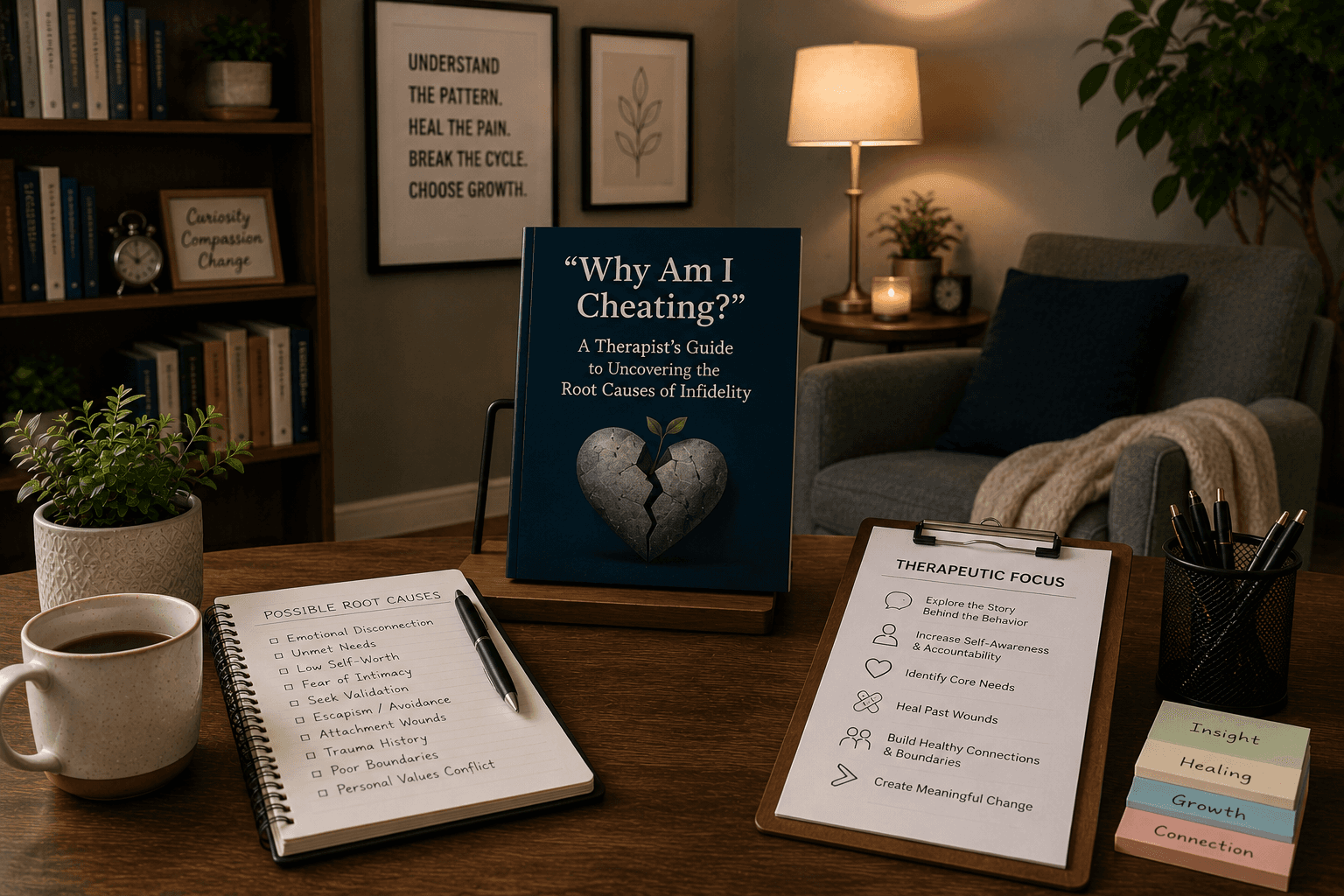
“Why Am I Cheating?” A Therapist’s Guide to Uncovering the Root Causes of Infidelity

Jul 7, 2026
The question “Why am I cheating?” rarely comes out of nowhere. It is born in the aftermath of discovery — or in the agonizing tension of a secret that can no longer be held. The client who asks it is often drowning in shame, confusion, and self-loathing. They may truly love their partner, yet they have violated the most fundamental agreement of their relationship. They are searching for an explanation that makes sense, not to excuse their behavior, but to understand themselves.
This is where the therapist’s work begins. The task is not to condone or condemn, but to explore with curiosity and compassion. The therapist must help the client untangle the complex web of motivations, vulnerabilities, and circumstances that led to the affair — without falling into the trap of oversimplification or moral judgment.
The “Bad Relationship” Myth
One of the most persistent misconceptions about infidelity is that it is always caused by relationship dissatisfaction. While relationship issues certainly contribute to many cases, research has identified three distinct categories of factors that can lead to affairs: relationship factors, individual factors, and socio-environmental factors. Talal Al-Saleem, a leading expert on infidelity, has emphasized that infidelity is not a one-size-fits-all phenomenon.
A comprehensive definition of infidelity is “the breach of contract of exclusivity that you have with your partner”. This shifts the focus from a universal judgment of “right” or “wrong” to an understanding of the unique relationship agreements each couple holds. What constitutes infidelity for one couple may not for another, depending on their boundaries and expectations.
This nuanced approach allows clinicians to move beyond the assumption that infidelity is always a symptom of a failing relationship. As one study found, low relationship satisfaction predicted a higher likelihood of infidelity, but relationship satisfaction alone does not explain all cases.
The Eight Key Motivations
A comprehensive study of 495 individuals who had cheated identified eight distinct motivations. These motivations not only explain why people cheat, but also influence the duration of the affair, emotional investment, sexual enjoyment, and whether the primary relationship ends:
Motivation | Description |
|---|---|
Anger | Cheating as a form of revenge or retaliation |
Self-esteem | Seeking validation or a boost to self-worth |
Lack of love | Feeling emotionally disconnected or unloved |
Low commitment | Low investment in the relationship |
Need for variety | Desire for novelty or excitement |
Neglect | Feeling ignored or undervalued |
Sexual desire | Pursuit of sexual satisfaction |
Situation or circumstance | Opportunistic cheating (e.g., intoxicated, overwhelmed) |
Cheating is rarely just about sex. Most participants felt some form of emotional attachment to their affair partner. Emotional intimacy in the affair was more common when the primary relationship was characterized by neglect or lack of love.
The Woolley Motivation Typology: A Clinical Framework
The Woolley Motivation Typology offers a practical framework for assessing the underlying motivations of an affair. It categorizes infidelity into three broad categories and seven specific types based on motivations:
Conflict-avoidant affairs: Driven by a desire to escape conflict or emotional pain in the primary relationship
Intimacy-seeking affairs: Stemming from a longing for emotional connection or validation that feels absent
Sexual desire affairs: Motivated by unmet sexual needs, variety-seeking, or compulsive sexual behavior
Exit affairs: Designed to end the primary relationship, consciously or unconsciously
Revenge affairs: A response to perceived betrayal or injury by the partner
Entitlement affairs: Rooted in a belief that the individual deserves or is entitled to the affair
Other (mixed or unclear motivations)
Understanding the motivation behind the affair is essential for guiding treatment. It helps clinicians reduce blaming, heal emotional wounds, create safe emotional connection, and prevent future infidelity.
The Role of Attachment and Childhood Trauma
Research has demonstrated a clear link between attachment style and infidelity. Individuals with insecure attachment styles are more likely to engage in infidelity. A study of 584 participants found that individuals with an avoidant attachment style — those who tend to distance themselves from emotional intimacy — are more likely to engage in infidelity.
Adverse childhood experiences (ACEs) are associated with both anxious and avoidant attachment styles, and avoidant attachment mediates the relationship between ACEs and cheating frequency. This suggests that early relational trauma can shape the attachment patterns that later contribute to infidelity.
Insecure attachment styles are positively associated with infidelity motivations such as anger, lack of love, neglect, low commitment, and esteem. These findings provide important guidance for therapeutic interventions targeting the root causes of infidelity.
Practical Steps for the Therapist
1. Normalize the Search for Understanding
The client who asks “Why am I cheating?” is often consumed by shame. Normalize their search for understanding. The goal is not to excuse their behavior, but to help them make sense of it, which is essential for change.
2. Explore the Full Range of Motivations
Help the client identify their primary motivation. Use the Woolley typology as a guide, but remain open to the possibility of mixed motivations. Ask open-ended questions:
“What were you seeking in the affair that you felt was missing in your primary relationship?”
“What was the emotional state of your relationship at the time?”
“Were there any external factors that contributed to the situation?”
3. Examine Attachment and Early Experiences
Explore the client’s attachment history. Early relational trauma may have shaped their approach to intimacy. Understanding the client’s attachment style can illuminate patterns that contribute to infidelity.
4. Address Underlying Issues
Avoid focusing solely on the affair itself. The affair is often a symptom of deeper issues — unmet needs, emotional disconnection, unresolved trauma, or personal vulnerabilities. Addressing these root causes is essential for preventing future infidelity.
5. Shift the Focus to the Future
The ultimate goal of infidelity counseling is not necessarily to save the relationship, but to help the client make an informed decision about the future. Whether the couple rebuilds or parts ways, the client should leave therapy with greater self-awareness and healthier relational patterns.
Frequently Asked Questions (FAQ)
1. Can someone cheat even if they are in a happy relationship?
Yes. While relationship dissatisfaction is a common factor, infidelity can also be driven by individual factors (e.g., low self-esteem, narcissism) or situational factors (e.g., opportunity, intoxication). The motivation behind the affair is key.
2. What if the client doesn’t know why they cheated?
This is common. The therapist’s role is to help the client explore the underlying factors through careful inquiry and reflection. The Woolley typology and the eight key motivations can provide a useful starting point.
3. How do I help a client who is deeply ashamed of their infidelity?
Normalize their shame while gently guiding them toward self-compassion. Shame inhibits insight and change. The goal is to help the client understand their behavior without being consumed by self-loathing.
4. Is infidelity always a sign that the relationship is over?
Not necessarily. Many couples successfully rebuild their relationship after infidelity. Approximately 85% of couples who use specialized infidelity therapy decide to repair their relationship. The outcome depends on the commitment of both partners and the underlying issues that contributed to the affair.
5. How can I prevent myself from being judgmental as a therapist?
Maintain a stance of curiosity rather than judgment. Focus on understanding the client’s experience rather than evaluating their behavior. Remember that the client is likely struggling with significant shame and that your role is to facilitate insight, not to impose moral judgment.
References
Scientific American. (2021). Why Do People in Relationships Cheat?
https://www.scientificamerican.com/article/why-do-people-in-relationships-cheat/
Woolley, S. R., & Koren, R. (2025). Using the Woolley Motivation Typology to Heal Infidelity With Emotionally Focused Therapy. European Journal of Mental Health, 20, 0035.
https://ejmh.semmelweis.hu/index.php/ejmh/article/view/300
Coyle, P., et al. (2025). Adverse childhood experiences and infidelity: The mediating roles of anxious and avoidant attachment styles. Family Process, 64(1), e13088.
https://pubmed.ncbi.nlm.nih.gov/39586740/
Josephs, L. (2018). The Dynamics of Infidelity: Applying Relationship Science to Psychotherapy Practice. American Psychological Association.
https://www.apa.org
Schramm, D. (2025). Betrayal, Infidelity, and Affair Recovery.
https://www.drdaveschramm.com/dr-daves-blog/betrayalinfidelityandaffairrecovery
Everyday Health. (2017). Why People Cheat — Even if They're in a Loving, Committed Relationship.
https://www.everydayhealth.com
The information in this article reflects clinical and research findings available as of 2025–2026. Clinical practice should always be guided by ongoing learning, supervision, and attention to the unique needs of each client.
If you’re ready to spend less time on documentation and more on therapy, get started with a free trial today
Not medical advice. For informational use only.
Outline
More articles